Branding
Digital Security & Cloud Services
Commercial &Residential CyberSecurity Services
Year :
2024
Industry :
CyberSecurity
Client :
Business Owner With Oracle Cloud
Project Duration :
ongoing
Problem :
Most people find out they have a security problem the same way — something breaks, something disappears, or they get a call they weren't expecting. Doesn't matter if you're a soldier, a plumber, a startup founder, or running a barbershop. The vulnerabilities are the same across the board.
No two-factor authentication on your email. A password that's been the same since 2011. Downloading software on a work computer without thinking twice about it. A new hire at a startup plugging in a personal USB drive because nobody told them not to. These aren't hacking movie moments — there's no guy in a hoodie writing code to break into your specific business. Most of the time, the information is already out there. Public data, old breaches, weak habits. Someone just has to use it against you.
I saw this pattern training soldiers in the military, and I see it now with business owners. The gap isn't technical — it's that nobody ever walked them through the basics. And honestly? A lot of what protects you doesn't require hiring anyone. It just requires knowing what to look at. That's where we start.

Solution :
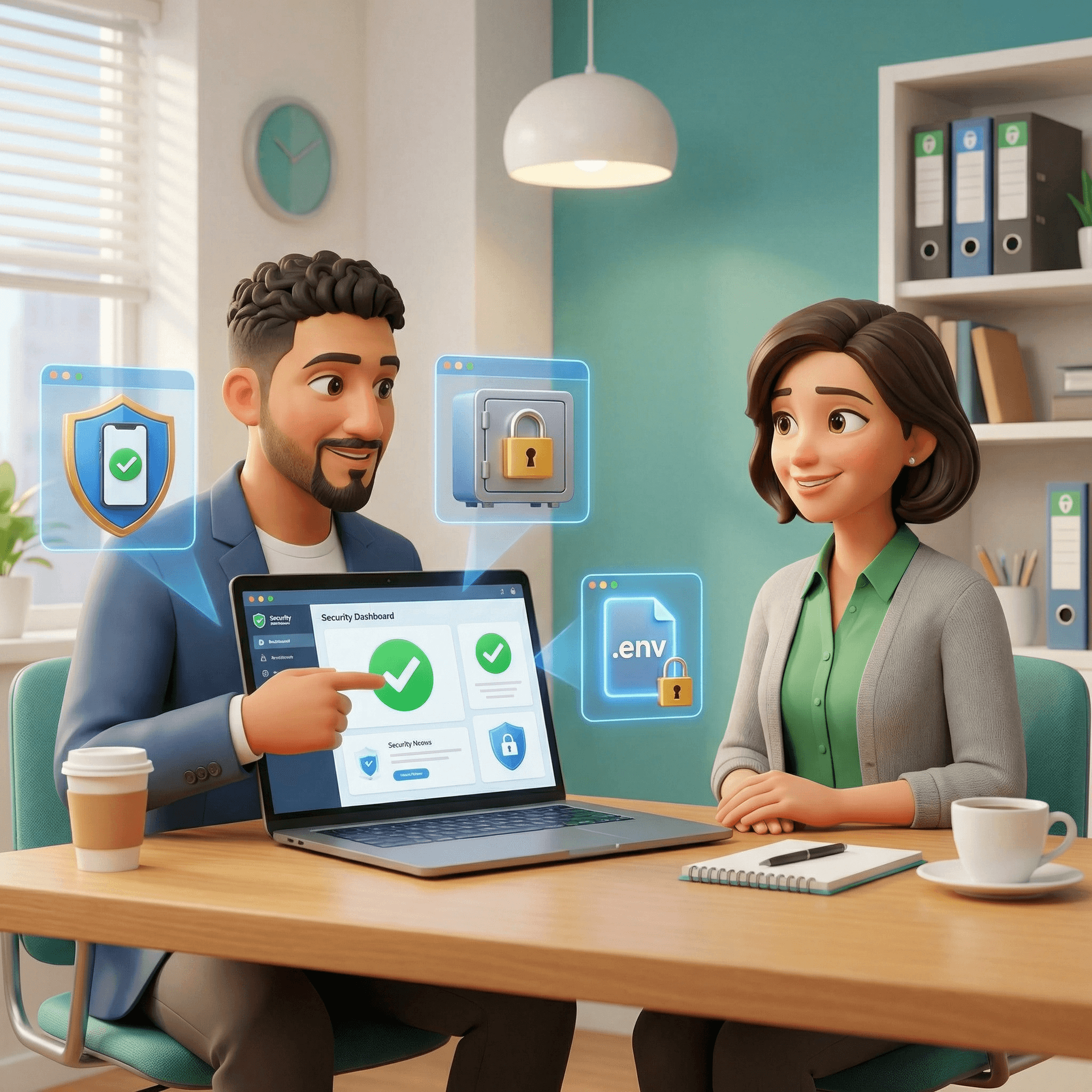
Before we touch any tools or set up any systems, we start with the basics — what you actually need to know to not get got. Password managers, two-factor authentication, recognizing a sketchy email before you click it. I put free content on YouTube for exactly this reason, because some of this stuff you can handle yourself once you know what you're looking at. For everything else — cloud hosting, payment security, account protection — I build it out under your name, your ownership, and make sure it stays locked down. You run your business. I make sure nobody's running it for you from the other side of the world.

Challenge :
Here's the thing most people don't want to hear: small businesses get hit more than big corporations. Not because you're a big target — but because you're an easier one. 43% of cyberattacks go after small businesses, and the number one reason they succeed is that the owner didn't think it would happen to them. I get it. It feels like a problem for companies with IT departments and big budgets. But a stolen password, an unsecured payment form, or a hijacked email account can shut you down just as fast — and cost you just as much. The challenge is getting ahead of it before something forces your hand.
Summary :
Hiring a professional isn't always the first step — and honestly, it shouldn't be. If you take a few hours to learn the basics of cybersecurity, you'll already be ahead of most people and most businesses. Password managers, two-factor authentication, understanding what not to click — that stuff is free, it's learnable, and it makes a real difference.
Where it gets more serious is when you start layering in software, automations, or agentic tools that touch your data, your clients, or your money. At that point, the small stuff matters a lot — how your environment files are structured, whether your repositories are properly secured, what legal exposure you might have depending on what you're building or storing. That's when a second set of eyes stops being optional.
Whether you're just getting started on your own or you've already got systems in place and want to make sure nothing's cracked open — I'm happy to point you in the right direction either way. No pitch, no pressure. Just an honest answer about where you stand.

More Projects



Branding
Digital Security & Cloud Services
Commercial &Residential CyberSecurity Services
Year :
2024
Industry :
CyberSecurity
Client :
Business Owner With Oracle Cloud
Project Duration :
ongoing
Problem :
Most people find out they have a security problem the same way — something breaks, something disappears, or they get a call they weren't expecting. Doesn't matter if you're a soldier, a plumber, a startup founder, or running a barbershop. The vulnerabilities are the same across the board.
No two-factor authentication on your email. A password that's been the same since 2011. Downloading software on a work computer without thinking twice about it. A new hire at a startup plugging in a personal USB drive because nobody told them not to. These aren't hacking movie moments — there's no guy in a hoodie writing code to break into your specific business. Most of the time, the information is already out there. Public data, old breaches, weak habits. Someone just has to use it against you.
I saw this pattern training soldiers in the military, and I see it now with business owners. The gap isn't technical — it's that nobody ever walked them through the basics. And honestly? A lot of what protects you doesn't require hiring anyone. It just requires knowing what to look at. That's where we start.
Solution :
Before we touch any tools or set up any systems, we start with the basics — what you actually need to know to not get got. Password managers, two-factor authentication, recognizing a sketchy email before you click it. I put free content on YouTube for exactly this reason, because some of this stuff you can handle yourself once you know what you're looking at. For everything else — cloud hosting, payment security, account protection — I build it out under your name, your ownership, and make sure it stays locked down. You run your business. I make sure nobody's running it for you from the other side of the world.
Challenge :
Here's the thing most people don't want to hear: small businesses get hit more than big corporations. Not because you're a big target — but because you're an easier one. 43% of cyberattacks go after small businesses, and the number one reason they succeed is that the owner didn't think it would happen to them. I get it. It feels like a problem for companies with IT departments and big budgets. But a stolen password, an unsecured payment form, or a hijacked email account can shut you down just as fast — and cost you just as much. The challenge is getting ahead of it before something forces your hand.
Summary :
Hiring a professional isn't always the first step — and honestly, it shouldn't be. If you take a few hours to learn the basics of cybersecurity, you'll already be ahead of most people and most businesses. Password managers, two-factor authentication, understanding what not to click — that stuff is free, it's learnable, and it makes a real difference.
Where it gets more serious is when you start layering in software, automations, or agentic tools that touch your data, your clients, or your money. At that point, the small stuff matters a lot — how your environment files are structured, whether your repositories are properly secured, what legal exposure you might have depending on what you're building or storing. That's when a second set of eyes stops being optional.
Whether you're just getting started on your own or you've already got systems in place and want to make sure nothing's cracked open — I'm happy to point you in the right direction either way. No pitch, no pressure. Just an honest answer about where you stand.
More Projects
Branding
Digital Security & Cloud Services
Commercial &Residential CyberSecurity Services
Year :
2024
Industry :
CyberSecurity
Client :
Business Owner With Oracle Cloud
Project Duration :
ongoing
Problem :
Most people find out they have a security problem the same way — something breaks, something disappears, or they get a call they weren't expecting. Doesn't matter if you're a soldier, a plumber, a startup founder, or running a barbershop. The vulnerabilities are the same across the board.
No two-factor authentication on your email. A password that's been the same since 2011. Downloading software on a work computer without thinking twice about it. A new hire at a startup plugging in a personal USB drive because nobody told them not to. These aren't hacking movie moments — there's no guy in a hoodie writing code to break into your specific business. Most of the time, the information is already out there. Public data, old breaches, weak habits. Someone just has to use it against you.
I saw this pattern training soldiers in the military, and I see it now with business owners. The gap isn't technical — it's that nobody ever walked them through the basics. And honestly? A lot of what protects you doesn't require hiring anyone. It just requires knowing what to look at. That's where we start.
Solution :
Before we touch any tools or set up any systems, we start with the basics — what you actually need to know to not get got. Password managers, two-factor authentication, recognizing a sketchy email before you click it. I put free content on YouTube for exactly this reason, because some of this stuff you can handle yourself once you know what you're looking at. For everything else — cloud hosting, payment security, account protection — I build it out under your name, your ownership, and make sure it stays locked down. You run your business. I make sure nobody's running it for you from the other side of the world.
Challenge :
Here's the thing most people don't want to hear: small businesses get hit more than big corporations. Not because you're a big target — but because you're an easier one. 43% of cyberattacks go after small businesses, and the number one reason they succeed is that the owner didn't think it would happen to them. I get it. It feels like a problem for companies with IT departments and big budgets. But a stolen password, an unsecured payment form, or a hijacked email account can shut you down just as fast — and cost you just as much. The challenge is getting ahead of it before something forces your hand.
Summary :
Hiring a professional isn't always the first step — and honestly, it shouldn't be. If you take a few hours to learn the basics of cybersecurity, you'll already be ahead of most people and most businesses. Password managers, two-factor authentication, understanding what not to click — that stuff is free, it's learnable, and it makes a real difference.
Where it gets more serious is when you start layering in software, automations, or agentic tools that touch your data, your clients, or your money. At that point, the small stuff matters a lot — how your environment files are structured, whether your repositories are properly secured, what legal exposure you might have depending on what you're building or storing. That's when a second set of eyes stops being optional.
Whether you're just getting started on your own or you've already got systems in place and want to make sure nothing's cracked open — I'm happy to point you in the right direction either way. No pitch, no pressure. Just an honest answer about where you stand.