How to Apply — The Basics of the N-400
Free study guide for the US citizenship civics test. Questions and answers in English and Spanish. No cost. No signup. Just study.
Tutorials
This Is Free — Study It, Share It With Someone Who Needs It
This guide was made for anyone preparing to take the US citizenship civics test. It does not matter where you are from or how long you have been here. If you are working toward becoming a US citizen this is for you and it is completely free.
Every question in this guide comes directly from the official USCIS source. Nothing is made up. Each question is written in English first then in Spanish so you can study in both.
If you filed your N-400 before October 20, 2025 you will take the 100 question version of the test. If you filed on or after that date you will take the updated 128 question version. Either way these questions cover what you need to know. Always check uscis.gov before your interview for any answers that may have changed due to elections or new appointments.
Videos walking through these questions out loud are coming to our YouTube channel. Subscribe so you do not miss them.
1. What is the supreme law of the land? The Constitution
1. ¿Cuál es la ley suprema del país? La Constitución
2. What does the Constitution do? Sets up the government / Defines the government / Protects basic rights of Americans
2. ¿Qué hace la Constitución? Establece el gobierno / Define el gobierno / Protege los derechos básicos de los estadounidenses
3. What are the first three words of the Constitution? We the People
3. ¿Cuáles son las primeras tres palabras de la Constitución? Nosotros el Pueblo
4. What do we call the first ten amendments to the Constitution? The Bill of Rights
4. ¿Cómo llamamos a las primeras diez enmiendas de la Constitución? La Carta de Derechos
5. What is one right or freedom from the First Amendment? Speech / Religion / Assembly / Press / Petition the government
5. ¿Cuál es un derecho o libertad de la Primera Enmienda? Expresión / Religión / Reunión / Prensa / Petición al gobierno
6. How many amendments does the Constitution have? Twenty-seven (27)
6. ¿Cuántas enmiendas tiene la Constitución? Veintisiete (27)
7. What did the Declaration of Independence do? Announced our independence from Great Britain / Said the United States is free from Great Britain
7. ¿Qué hizo la Declaración de Independencia? Anunció nuestra independencia de Gran Bretaña / Dijo que Estados Unidos es libre de Gran Bretaña
8. What are two rights in the Declaration of Independence? Life / Liberty / Pursuit of happiness
8. ¿Cuáles son dos derechos en la Declaración de Independencia? Vida / Libertad / Búsqueda de la felicidad
9. What is freedom of religion? You can practice any religion or not practice a religion
9. ¿Qué es la libertad de religión? Puedes practicar cualquier religión o no practicar ninguna
10. What is the economic system in the United States? Capitalist economy / Market economy
10. ¿Cuál es el sistema económico de los Estados Unidos? Economía capitalista / Economía de mercado
11. What is the rule of law? Everyone must follow the law / No one is above the law / Leaders must obey the law
11. ¿Qué es el estado de derecho? Todos deben seguir la ley / Nadie está por encima de la ley / Los líderes deben obedecer la ley
12. Name one branch or part of the government. Congress / Legislative / President / Executive / The courts / Judicial
12. Nombre una rama o parte del gobierno. Congreso / Legislativo / Presidente / Ejecutivo / Los tribunales / Judicial
13. What stops one branch of government from becoming too powerful? Checks and balances / Separation of powers
13. ¿Qué impide que una rama del gobierno se vuelva demasiado poderosa? Controles y contrapesos / Separación de poderes
14. Who is in charge of the executive branch? The President
14. ¿Quién está a cargo de la rama ejecutiva? El Presidente
15. Who makes federal laws? Congress / Senate and House of Representatives
15. ¿Quién hace las leyes federales? El Congreso / El Senado y la Cámara de Representantes

Questions 16 Through 30
16. What are the two parts of the US Congress? The Senate and House of Representatives
16. ¿Cuáles son las dos partes del Congreso de los Estados Unidos? El Senado y la Cámara de Representantes
17. How many US Senators are there? One hundred (100)
17. ¿Cuántos senadores de los Estados Unidos hay? Cien (100)
18. We elect a US Senator for how many years? Six (6)
18. ¿Por cuántos años elegimos a un senador de los Estados Unidos? Seis (6)
19. Who is one of your state's US Senators now? Answers will vary — Texas Senators are Ted Cruz and John Cornyn
19. ¿Quién es uno de los senadores de su estado ahora? Las respuestas varían — Los senadores de Texas son Ted Cruz y John Cornyn
20. The House of Representatives has how many voting members? Four hundred thirty-five (435)
20. ¿Cuántos miembros votantes tiene la Cámara de Representantes? Cuatrocientos treinta y cinco (435)
21. We elect a US Representative for how many years? Two (2)
21. ¿Por cuántos años elegimos a un representante de los Estados Unidos? Dos (2)
22. Who does a US Senator represent? All people of the state
22. ¿A quién representa un senador de los Estados Unidos? A toda la gente del estado
23. Why do some states have more Representatives than other states? Because of the state's population / Because some states have more people
23. ¿Por qué algunos estados tienen más representantes que otros? Debido a la población del estado / Porque algunos estados tienen más personas
24. We elect a President for how many years? Four (4)
24. ¿Por cuántos años elegimos a un presidente? Cuatro (4)
25. In what month do we vote for President? November
25. ¿En qué mes votamos por el presidente? Noviembre
26. What is the name of the President of the United States now? Donald J. Trump
26. ¿Cuál es el nombre del presidente de los Estados Unidos ahora? Donald J. Trump
27. What is the name of the Vice President now? JD Vance
27. ¿Cuál es el nombre del vicepresidente ahora? JD Vance
28. If the President can no longer serve who becomes President? The Vice President
28. Si el presidente ya no puede servir ¿quién se convierte en presidente? El Vicepresidente
29. If both the President and Vice President can no longer serve who becomes President? The Speaker of the House
29. Si tanto el presidente como el vicepresidente ya no pueden servir ¿quién se convierte en presidente? El Presidente de la Cámara de Representantes
30. Who is the Commander in Chief of the military? The President
30. ¿Quién es el Comandante en Jefe de las fuerzas militares? El Presidente

Questions 31 Through 42
31. Who signs bills to become laws? The President
31. ¿Quién firma los proyectos de ley para convertirlos en leyes? El Presidente
32. Who vetoes bills? The President
32. ¿Quién veta los proyectos de ley? El Presidente
33. What does the President's Cabinet do? Advises the President
33. ¿Qué hace el Gabinete del Presidente? Asesora al Presidente
34. What are two Cabinet-level positions? Secretary of State / Secretary of Defense / Attorney General / Vice President
34. ¿Cuáles son dos posiciones a nivel de Gabinete? Secretario de Estado / Secretario de Defensa / Fiscal General / Vicepresidente
35. What does the judicial branch do? Reviews laws / Explains laws / Resolves disputes / Decides if a law goes against the Constitution
35. ¿Qué hace la rama judicial? Revisa las leyes / Explica las leyes / Resuelve disputas / Decide si una ley va contra la Constitución
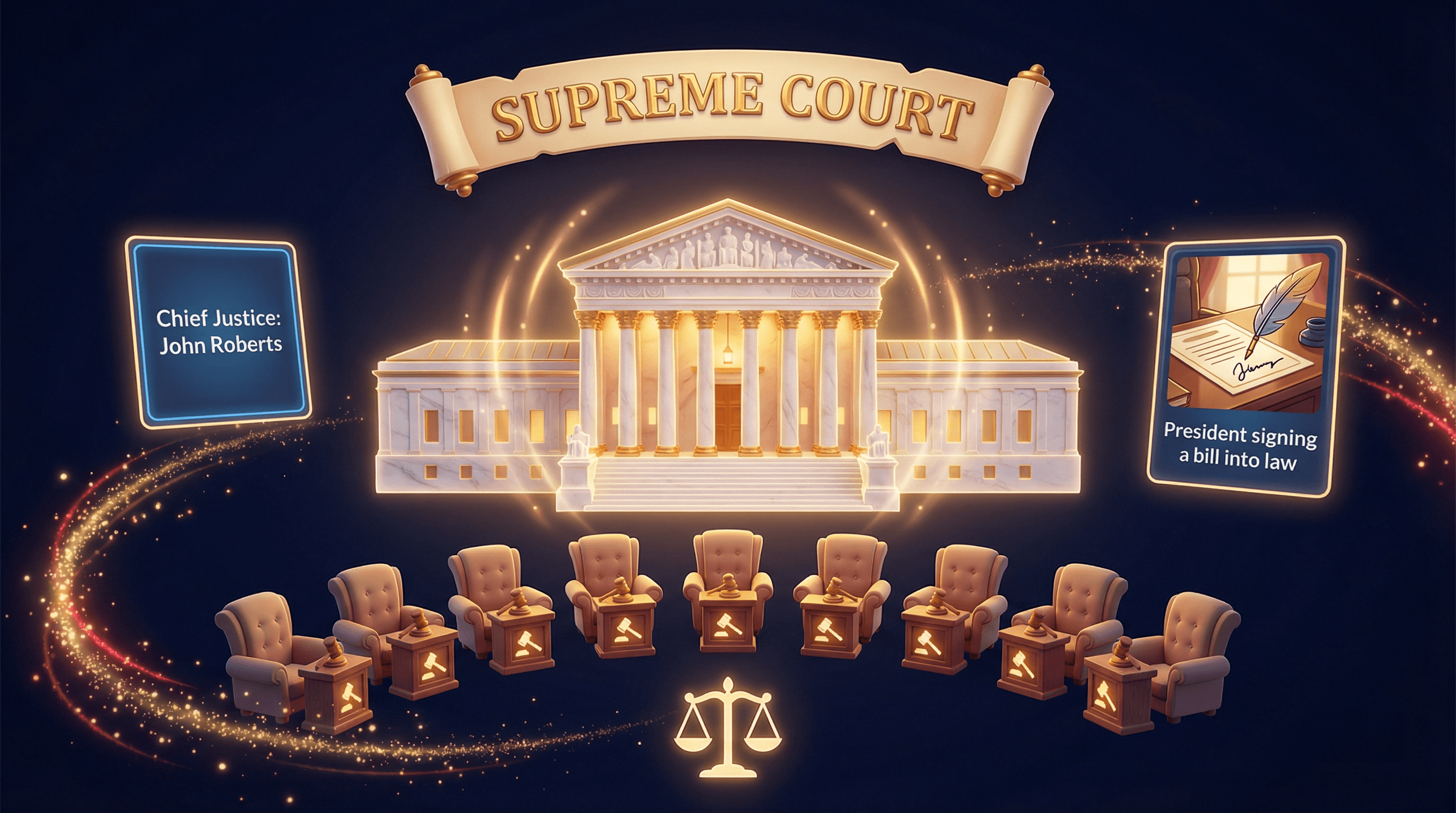
36. What is the highest court in the United States? The Supreme Court
36. ¿Cuál es el tribunal más alto de los Estados Unidos? La Corte Suprema
37. How many justices are on the Supreme Court? Nine (9)
37. ¿Cuántos jueces hay en la Corte Suprema? Nueve (9)
38. Who is the Chief Justice of the United States now? John Roberts
38. ¿Quién es el Presidente del Tribunal Supremo ahora? John Roberts
39. What is one power of the federal government? To print money / To declare war / To create an army / To make treaties
39. ¿Cuál es un poder del gobierno federal? Imprimir dinero / Declarar la guerra / Crear un ejército / Hacer tratados
40. What is one power of the states? Provide education / Provide police protection / Give a driver's license / Approve zoning and land use
40. ¿Cuál es un poder de los estados? Proporcionar educación / Proporcionar protección policial / Dar licencias de conducir / Aprobar zonificación
41. Who is the Governor of your state now? Answers will vary — Texas Governor is Greg Abbott
41. ¿Quién es el gobernador de su estado ahora? Las respuestas varían — El Gobernador de Texas es Greg Abbott
42. What is the capital of your state? Answers will vary — Texas capital is Austin
42. ¿Cuál es la capital de su estado? Las respuestas varían — La capital de Texas es Austin
CONTENT - 4
Questions 43 Through 50
43. What are the two major political parties in the United States? Democratic and Republican
43. ¿Cuáles son los dos principales partidos políticos en los Estados Unidos? Demócrata y Republicano
44. What is the political party of the President now? Republican
44. ¿Cuál es el partido político del presidente ahora? Republicano
45. What is the name of the Speaker of the House now? Mike Johnson
45. ¿Cuál es el nombre del Presidente de la Cámara de Representantes ahora? Mike Johnson
46. There are four amendments about who can vote. Describe one. Citizens eighteen and older can vote / You do not have to pay a poll tax to vote / Any citizen can vote / A male citizen of any race can vote
46. Hay cuatro enmiendas sobre quién puede votar. Describa una. Los ciudadanos de dieciocho años o más pueden votar / No tienes que pagar para votar / Cualquier ciudadano puede votar
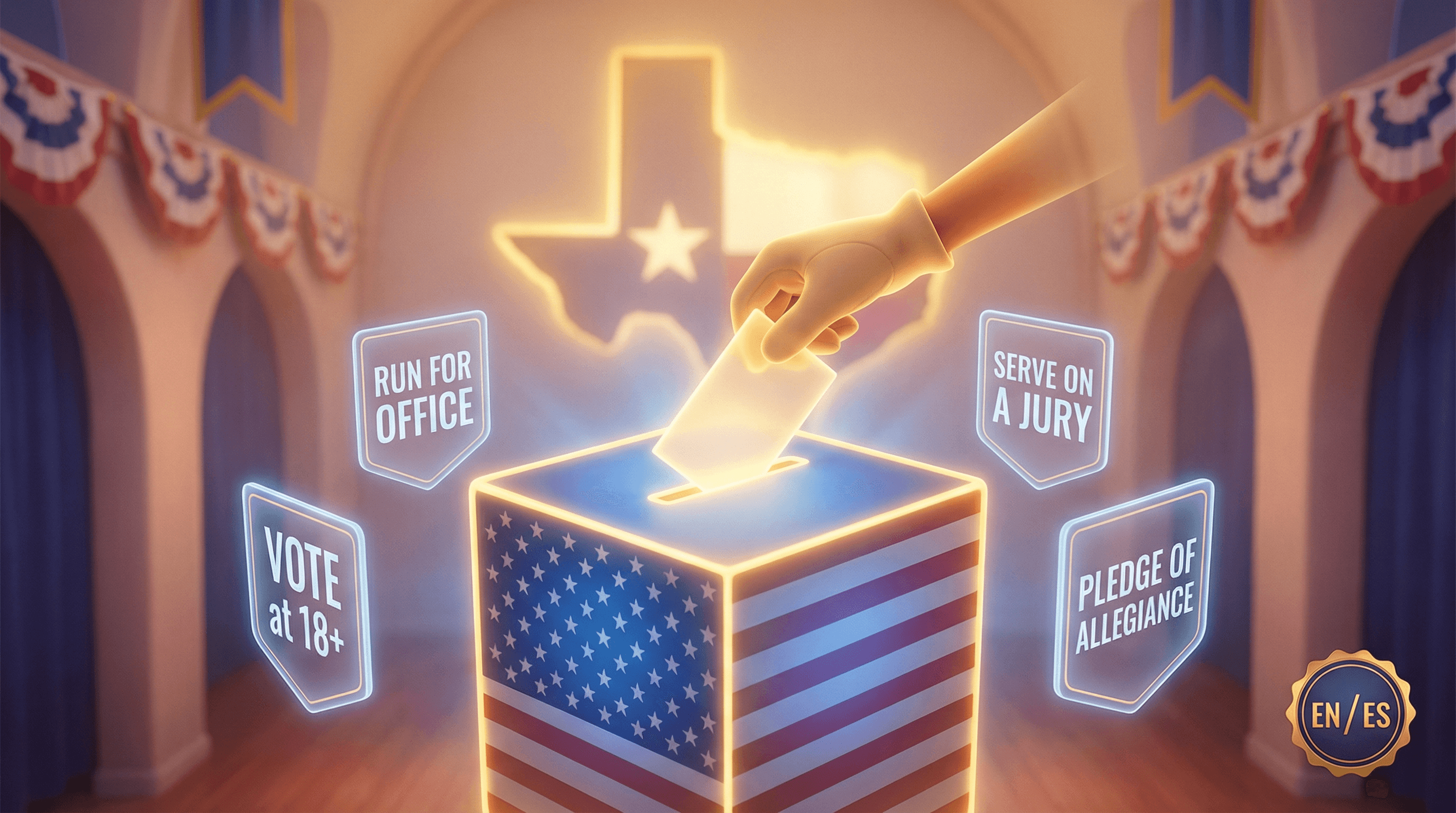
47. What is one responsibility that is only for United States citizens? Serve on a jury / Vote in a federal election
47. ¿Cuál es una responsabilidad que es solo para ciudadanos de los Estados Unidos? Servir en un jurado / Votar en una elección federal
48. Name one right only for United States citizens. Vote in a federal election / Run for federal office
48. Nombre un derecho solo para ciudadanos de los Estados Unidos. Votar en una elección federal / Postularse para un cargo federal
49. What are two rights of everyone living in the United States? Freedom of expression / Freedom of speech / Freedom of assembly / Freedom of religion / Right to bear arms
49. ¿Cuáles son dos derechos de todos los que viven en los Estados Unidos? Libertad de expresión / Libertad de reunión / Libertad de religión / Derecho a portar armas
50. What do we show loyalty to when we say the Pledge of Allegiance? The United States / The flag
50. ¿A qué mostramos lealtad cuando decimos el Juramento de Lealtad? Los Estados Unidos / La bandera

5. Leverage Templates, Presets, and Design SystemsHere we go:
TITLE US Citizenship Test Study Guide — Part 2 (Questions 51–75)
SLUG us-citizenship-test-study-guide-part-2
DATE 04/08/2026
CATEGORY TYPE Resources
PINNED POST Yes
FEATURED Yes
DESCRIPTION Free study guide for the US citizenship civics test. Questions 51 through 75 in English and Spanish. No cost. No signup. Just study.
CONTENT - 1
Keep Going — You Are Halfway There
This is Part 2 of the free US citizenship civics test study guide. If you have not studied Part 1 yet go back and start there. This section covers questions 51 through 75. Same format — English first then Spanish. Study both.
Videos going through these questions out loud are coming to our YouTube channel. Subscribe and study along.
51. What is one promise you make when you become a United States citizen? Give up loyalty to other countries / Defend the Constitution and laws of the United States / Obey the laws of the United States / Serve in the US military if needed / Serve the nation if needed / Be loyal to the United States
51. ¿Cuál es una promesa que haces cuando te conviertes en ciudadano de los Estados Unidos? Renunciar a la lealtad a otros países / Defender la Constitución y las leyes de los Estados Unidos / Obedecer las leyes / Servir en el ejército si es necesario / Ser leal a los Estados Unidos
52. How old do citizens have to be to vote for President? Eighteen (18) and older
52. ¿Qué edad deben tener los ciudadanos para votar por el presidente? Dieciocho (18) años o más
53. What are two ways that Americans can participate in their democracy? Vote / Join a political party / Help with a campaign / Join a civic group / Join a community group / Give an elected official your opinion / Call your senators and representatives / Publicly support or oppose an issue / Run for office / Write to a newspaper
53. ¿Cuáles son dos formas en que los estadounidenses pueden participar en su democracia? Votar / Unirse a un partido político / Ayudar en una campaña / Unirse a un grupo cívico / Llamar a sus senadores y representantes / Postularse para un cargo
54. When is the last day you can send in federal income tax forms? April 15
54. ¿Cuál es el último día para enviar los formularios de impuestos federales sobre la renta? El 15 de abril
55. When must all men register for the Selective Service? At age eighteen / Between eighteen and twenty-six
55. ¿Cuándo deben registrarse todos los hombres en el Servicio Selectivo? A los dieciocho años / Entre los dieciocho y los veintiséis años
CONTENT - 2
Questions 56 Through 65
56. Who lived in America before the Europeans arrived? American Indians / Native Americans
56. ¿Quién vivía en América antes de que llegaran los europeos? Indios americanos / Nativos americanos
57. What group of people was taken to America and sold as slaves? Africans / People from Africa
57. ¿Qué grupo de personas fue llevado a América y vendido como esclavos? Africanos / Personas de África
58. What war did the Americans fight to win independence from Britain? The American Revolution
58. ¿Qué guerra lucharon los estadounidenses para ganar la independencia de Gran Bretaña? La Revolución Americana
59. Who wrote the Declaration of Independence? Thomas Jefferson
59. ¿Quién escribió la Declaración de Independencia? Thomas Jefferson
60. When was the Declaration of Independence adopted? July 4 1776
60. ¿Cuándo se adoptó la Declaración de Independencia? El 4 de julio de 1776
61. There were 13 original states. Name three. New Hampshire / Massachusetts / Rhode Island / Connecticut / New York / New Jersey / Pennsylvania / Delaware / Maryland / Virginia / North Carolina / South Carolina / Georgia
61. Había 13 estados originales. Nombre tres. Nueva Hampshire / Massachusetts / Rhode Island / Connecticut / Nueva York / Nueva Jersey / Pensilvania / Delaware / Maryland / Virginia / Carolina del Norte / Carolina del Sur / Georgia
62. What happened at the Constitutional Convention? The Constitution was written / The Founding Fathers wrote the Constitution
62. ¿Qué pasó en la Convención Constitucional? Se escribió la Constitución / Los Padres Fundadores escribieron la Constitución
63. When was the Constitution written? 1787
63. ¿Cuándo se escribió la Constitución? 1787
64. The Federalist Papers supported the passage of the US Constitution. Name one of the writers. James Madison / Alexander Hamilton / John Jay / Publius
64. Los Federalist Papers apoyaron la aprobación de la Constitución. Nombre uno de los escritores. James Madison / Alexander Hamilton / John Jay / Publius
65. What is one thing Benjamin Franklin is famous for? US diplomat / Oldest member of the Constitutional Convention / First Postmaster General of the United States / Writer of Poor Richard's Almanac / Started the first free libraries
65. ¿Por qué es famoso Benjamín Franklin? Diplomático de los Estados Unidos / Miembro más anciano de la Convención Constitucional / Primer Director General de Correos / Escritor del Almanaque del Pobre Ricardo / Inició las primeras bibliotecas gratuitas
CONTENT - 3
Questions 66 Through 75
66. Who is the Father of Our Country? George Washington
66. ¿Quién es el Padre de nuestra Patria? George Washington
67. Who was the first President? George Washington
67. ¿Quién fue el primer presidente? George Washington
68. What territory did the United States buy from France in 1803? The Louisiana Territory / Louisiana
68. ¿Qué territorio compró Estados Unidos a Francia en 1803? El Territorio de Luisiana / Luisiana
69. Name one war fought by the United States in the 1800s. War of 1812 / Mexican-American War / Civil War / Spanish-American War
69. Nombre una guerra en la que participaron los Estados Unidos en el siglo XIX. Guerra de 1812 / Guerra México-Americana / Guerra Civil / Guerra Hispano-Americana
70. Name the US war between the North and the South. The Civil War / The War Between the States
70. Nombre la guerra de los Estados Unidos entre el Norte y el Sur. La Guerra Civil / La Guerra entre los Estados
71. Name one problem that led to the Civil War. Slavery / Economic reasons / States rights
71. Nombre un problema que llevó a la Guerra Civil. La esclavitud / Razones económicas / Los derechos de los estados
72. What was one important thing Abraham Lincoln did? Freed the slaves — Emancipation Proclamation / Saved or preserved the Union / Led the United States during the Civil War
72. ¿Cuál fue una cosa importante que hizo Abraham Lincoln? Liberó a los esclavos — Proclamación de Emancipación / Salvó la Unión / Lideró los Estados Unidos durante la Guerra Civil
73. What did the Emancipation Proclamation do? Freed the slaves / Freed slaves in the Confederacy / Freed slaves in the Confederate states / Freed slaves in most Southern states
73. ¿Qué hizo la Proclamación de Emancipación? Liberó a los esclavos / Liberó a los esclavos en la Confederación / Liberó a los esclavos en la mayoría de los estados del Sur
74. What did Susan B. Anthony do? Fought for women's rights / Fought for civil rights
74. ¿Qué hizo Susan B. Anthony? Luchó por los derechos de la mujer / Luchó por los derechos civiles
75. Name one war fought by the United States in the early 1900s. World War One / Other: Philippine-American War / Banana Wars
75. Nombre una guerra en la que participaron los Estados Unidos a principios del siglo XX. Primera Guerra Mundial / Guerra Hispano-Filipina / Guerras Bananeras
More to Discover

How to Apply — The Basics of the N-400
Free study guide for the US citizenship civics test. Questions and answers in English and Spanish. No cost. No signup. Just study.
Tutorials
This Is Free — Study It, Share It With Someone Who Needs It
This guide was made for anyone preparing to take the US citizenship civics test. It does not matter where you are from or how long you have been here. If you are working toward becoming a US citizen this is for you and it is completely free.
Every question in this guide comes directly from the official USCIS source. Nothing is made up. Each question is written in English first then in Spanish so you can study in both.
If you filed your N-400 before October 20, 2025 you will take the 100 question version of the test. If you filed on or after that date you will take the updated 128 question version. Either way these questions cover what you need to know. Always check uscis.gov before your interview for any answers that may have changed due to elections or new appointments.
Videos walking through these questions out loud are coming to our YouTube channel. Subscribe so you do not miss them.
1. What is the supreme law of the land? The Constitution
1. ¿Cuál es la ley suprema del país? La Constitución
2. What does the Constitution do? Sets up the government / Defines the government / Protects basic rights of Americans
2. ¿Qué hace la Constitución? Establece el gobierno / Define el gobierno / Protege los derechos básicos de los estadounidenses
3. What are the first three words of the Constitution? We the People
3. ¿Cuáles son las primeras tres palabras de la Constitución? Nosotros el Pueblo
4. What do we call the first ten amendments to the Constitution? The Bill of Rights
4. ¿Cómo llamamos a las primeras diez enmiendas de la Constitución? La Carta de Derechos
5. What is one right or freedom from the First Amendment? Speech / Religion / Assembly / Press / Petition the government
5. ¿Cuál es un derecho o libertad de la Primera Enmienda? Expresión / Religión / Reunión / Prensa / Petición al gobierno
6. How many amendments does the Constitution have? Twenty-seven (27)
6. ¿Cuántas enmiendas tiene la Constitución? Veintisiete (27)
7. What did the Declaration of Independence do? Announced our independence from Great Britain / Said the United States is free from Great Britain
7. ¿Qué hizo la Declaración de Independencia? Anunció nuestra independencia de Gran Bretaña / Dijo que Estados Unidos es libre de Gran Bretaña
8. What are two rights in the Declaration of Independence? Life / Liberty / Pursuit of happiness
8. ¿Cuáles son dos derechos en la Declaración de Independencia? Vida / Libertad / Búsqueda de la felicidad
9. What is freedom of religion? You can practice any religion or not practice a religion
9. ¿Qué es la libertad de religión? Puedes practicar cualquier religión o no practicar ninguna
10. What is the economic system in the United States? Capitalist economy / Market economy
10. ¿Cuál es el sistema económico de los Estados Unidos? Economía capitalista / Economía de mercado
11. What is the rule of law? Everyone must follow the law / No one is above the law / Leaders must obey the law
11. ¿Qué es el estado de derecho? Todos deben seguir la ley / Nadie está por encima de la ley / Los líderes deben obedecer la ley
12. Name one branch or part of the government. Congress / Legislative / President / Executive / The courts / Judicial
12. Nombre una rama o parte del gobierno. Congreso / Legislativo / Presidente / Ejecutivo / Los tribunales / Judicial
13. What stops one branch of government from becoming too powerful? Checks and balances / Separation of powers
13. ¿Qué impide que una rama del gobierno se vuelva demasiado poderosa? Controles y contrapesos / Separación de poderes
14. Who is in charge of the executive branch? The President
14. ¿Quién está a cargo de la rama ejecutiva? El Presidente
15. Who makes federal laws? Congress / Senate and House of Representatives
15. ¿Quién hace las leyes federales? El Congreso / El Senado y la Cámara de Representantes
Questions 16 Through 30
16. What are the two parts of the US Congress? The Senate and House of Representatives
16. ¿Cuáles son las dos partes del Congreso de los Estados Unidos? El Senado y la Cámara de Representantes
17. How many US Senators are there? One hundred (100)
17. ¿Cuántos senadores de los Estados Unidos hay? Cien (100)
18. We elect a US Senator for how many years? Six (6)
18. ¿Por cuántos años elegimos a un senador de los Estados Unidos? Seis (6)
19. Who is one of your state's US Senators now? Answers will vary — Texas Senators are Ted Cruz and John Cornyn
19. ¿Quién es uno de los senadores de su estado ahora? Las respuestas varían — Los senadores de Texas son Ted Cruz y John Cornyn
20. The House of Representatives has how many voting members? Four hundred thirty-five (435)
20. ¿Cuántos miembros votantes tiene la Cámara de Representantes? Cuatrocientos treinta y cinco (435)
21. We elect a US Representative for how many years? Two (2)
21. ¿Por cuántos años elegimos a un representante de los Estados Unidos? Dos (2)
22. Who does a US Senator represent? All people of the state
22. ¿A quién representa un senador de los Estados Unidos? A toda la gente del estado
23. Why do some states have more Representatives than other states? Because of the state's population / Because some states have more people
23. ¿Por qué algunos estados tienen más representantes que otros? Debido a la población del estado / Porque algunos estados tienen más personas
24. We elect a President for how many years? Four (4)
24. ¿Por cuántos años elegimos a un presidente? Cuatro (4)
25. In what month do we vote for President? November
25. ¿En qué mes votamos por el presidente? Noviembre
26. What is the name of the President of the United States now? Donald J. Trump
26. ¿Cuál es el nombre del presidente de los Estados Unidos ahora? Donald J. Trump
27. What is the name of the Vice President now? JD Vance
27. ¿Cuál es el nombre del vicepresidente ahora? JD Vance
28. If the President can no longer serve who becomes President? The Vice President
28. Si el presidente ya no puede servir ¿quién se convierte en presidente? El Vicepresidente
29. If both the President and Vice President can no longer serve who becomes President? The Speaker of the House
29. Si tanto el presidente como el vicepresidente ya no pueden servir ¿quién se convierte en presidente? El Presidente de la Cámara de Representantes
30. Who is the Commander in Chief of the military? The President
30. ¿Quién es el Comandante en Jefe de las fuerzas militares? El Presidente
Questions 31 Through 42
31. Who signs bills to become laws? The President
31. ¿Quién firma los proyectos de ley para convertirlos en leyes? El Presidente
32. Who vetoes bills? The President
32. ¿Quién veta los proyectos de ley? El Presidente
33. What does the President's Cabinet do? Advises the President
33. ¿Qué hace el Gabinete del Presidente? Asesora al Presidente
34. What are two Cabinet-level positions? Secretary of State / Secretary of Defense / Attorney General / Vice President
34. ¿Cuáles son dos posiciones a nivel de Gabinete? Secretario de Estado / Secretario de Defensa / Fiscal General / Vicepresidente
35. What does the judicial branch do? Reviews laws / Explains laws / Resolves disputes / Decides if a law goes against the Constitution
35. ¿Qué hace la rama judicial? Revisa las leyes / Explica las leyes / Resuelve disputas / Decide si una ley va contra la Constitución
36. What is the highest court in the United States? The Supreme Court
36. ¿Cuál es el tribunal más alto de los Estados Unidos? La Corte Suprema
37. How many justices are on the Supreme Court? Nine (9)
37. ¿Cuántos jueces hay en la Corte Suprema? Nueve (9)
38. Who is the Chief Justice of the United States now? John Roberts
38. ¿Quién es el Presidente del Tribunal Supremo ahora? John Roberts
39. What is one power of the federal government? To print money / To declare war / To create an army / To make treaties
39. ¿Cuál es un poder del gobierno federal? Imprimir dinero / Declarar la guerra / Crear un ejército / Hacer tratados
40. What is one power of the states? Provide education / Provide police protection / Give a driver's license / Approve zoning and land use
40. ¿Cuál es un poder de los estados? Proporcionar educación / Proporcionar protección policial / Dar licencias de conducir / Aprobar zonificación
41. Who is the Governor of your state now? Answers will vary — Texas Governor is Greg Abbott
41. ¿Quién es el gobernador de su estado ahora? Las respuestas varían — El Gobernador de Texas es Greg Abbott
42. What is the capital of your state? Answers will vary — Texas capital is Austin
42. ¿Cuál es la capital de su estado? Las respuestas varían — La capital de Texas es Austin
CONTENT - 4
Questions 43 Through 50
43. What are the two major political parties in the United States? Democratic and Republican
43. ¿Cuáles son los dos principales partidos políticos en los Estados Unidos? Demócrata y Republicano
44. What is the political party of the President now? Republican
44. ¿Cuál es el partido político del presidente ahora? Republicano
45. What is the name of the Speaker of the House now? Mike Johnson
45. ¿Cuál es el nombre del Presidente de la Cámara de Representantes ahora? Mike Johnson
46. There are four amendments about who can vote. Describe one. Citizens eighteen and older can vote / You do not have to pay a poll tax to vote / Any citizen can vote / A male citizen of any race can vote
46. Hay cuatro enmiendas sobre quién puede votar. Describa una. Los ciudadanos de dieciocho años o más pueden votar / No tienes que pagar para votar / Cualquier ciudadano puede votar
47. What is one responsibility that is only for United States citizens? Serve on a jury / Vote in a federal election
47. ¿Cuál es una responsabilidad que es solo para ciudadanos de los Estados Unidos? Servir en un jurado / Votar en una elección federal
48. Name one right only for United States citizens. Vote in a federal election / Run for federal office
48. Nombre un derecho solo para ciudadanos de los Estados Unidos. Votar en una elección federal / Postularse para un cargo federal
49. What are two rights of everyone living in the United States? Freedom of expression / Freedom of speech / Freedom of assembly / Freedom of religion / Right to bear arms
49. ¿Cuáles son dos derechos de todos los que viven en los Estados Unidos? Libertad de expresión / Libertad de reunión / Libertad de religión / Derecho a portar armas
50. What do we show loyalty to when we say the Pledge of Allegiance? The United States / The flag
50. ¿A qué mostramos lealtad cuando decimos el Juramento de Lealtad? Los Estados Unidos / La bandera
5. Leverage Templates, Presets, and Design SystemsHere we go:
TITLE US Citizenship Test Study Guide — Part 2 (Questions 51–75)
SLUG us-citizenship-test-study-guide-part-2
DATE 04/08/2026
CATEGORY TYPE Resources
PINNED POST Yes
FEATURED Yes
DESCRIPTION Free study guide for the US citizenship civics test. Questions 51 through 75 in English and Spanish. No cost. No signup. Just study.
CONTENT - 1
Keep Going — You Are Halfway There
This is Part 2 of the free US citizenship civics test study guide. If you have not studied Part 1 yet go back and start there. This section covers questions 51 through 75. Same format — English first then Spanish. Study both.
Videos going through these questions out loud are coming to our YouTube channel. Subscribe and study along.
51. What is one promise you make when you become a United States citizen? Give up loyalty to other countries / Defend the Constitution and laws of the United States / Obey the laws of the United States / Serve in the US military if needed / Serve the nation if needed / Be loyal to the United States
51. ¿Cuál es una promesa que haces cuando te conviertes en ciudadano de los Estados Unidos? Renunciar a la lealtad a otros países / Defender la Constitución y las leyes de los Estados Unidos / Obedecer las leyes / Servir en el ejército si es necesario / Ser leal a los Estados Unidos
52. How old do citizens have to be to vote for President? Eighteen (18) and older
52. ¿Qué edad deben tener los ciudadanos para votar por el presidente? Dieciocho (18) años o más
53. What are two ways that Americans can participate in their democracy? Vote / Join a political party / Help with a campaign / Join a civic group / Join a community group / Give an elected official your opinion / Call your senators and representatives / Publicly support or oppose an issue / Run for office / Write to a newspaper
53. ¿Cuáles son dos formas en que los estadounidenses pueden participar en su democracia? Votar / Unirse a un partido político / Ayudar en una campaña / Unirse a un grupo cívico / Llamar a sus senadores y representantes / Postularse para un cargo
54. When is the last day you can send in federal income tax forms? April 15
54. ¿Cuál es el último día para enviar los formularios de impuestos federales sobre la renta? El 15 de abril
55. When must all men register for the Selective Service? At age eighteen / Between eighteen and twenty-six
55. ¿Cuándo deben registrarse todos los hombres en el Servicio Selectivo? A los dieciocho años / Entre los dieciocho y los veintiséis años
CONTENT - 2
Questions 56 Through 65
56. Who lived in America before the Europeans arrived? American Indians / Native Americans
56. ¿Quién vivía en América antes de que llegaran los europeos? Indios americanos / Nativos americanos
57. What group of people was taken to America and sold as slaves? Africans / People from Africa
57. ¿Qué grupo de personas fue llevado a América y vendido como esclavos? Africanos / Personas de África
58. What war did the Americans fight to win independence from Britain? The American Revolution
58. ¿Qué guerra lucharon los estadounidenses para ganar la independencia de Gran Bretaña? La Revolución Americana
59. Who wrote the Declaration of Independence? Thomas Jefferson
59. ¿Quién escribió la Declaración de Independencia? Thomas Jefferson
60. When was the Declaration of Independence adopted? July 4 1776
60. ¿Cuándo se adoptó la Declaración de Independencia? El 4 de julio de 1776
61. There were 13 original states. Name three. New Hampshire / Massachusetts / Rhode Island / Connecticut / New York / New Jersey / Pennsylvania / Delaware / Maryland / Virginia / North Carolina / South Carolina / Georgia
61. Había 13 estados originales. Nombre tres. Nueva Hampshire / Massachusetts / Rhode Island / Connecticut / Nueva York / Nueva Jersey / Pensilvania / Delaware / Maryland / Virginia / Carolina del Norte / Carolina del Sur / Georgia
62. What happened at the Constitutional Convention? The Constitution was written / The Founding Fathers wrote the Constitution
62. ¿Qué pasó en la Convención Constitucional? Se escribió la Constitución / Los Padres Fundadores escribieron la Constitución
63. When was the Constitution written? 1787
63. ¿Cuándo se escribió la Constitución? 1787
64. The Federalist Papers supported the passage of the US Constitution. Name one of the writers. James Madison / Alexander Hamilton / John Jay / Publius
64. Los Federalist Papers apoyaron la aprobación de la Constitución. Nombre uno de los escritores. James Madison / Alexander Hamilton / John Jay / Publius
65. What is one thing Benjamin Franklin is famous for? US diplomat / Oldest member of the Constitutional Convention / First Postmaster General of the United States / Writer of Poor Richard's Almanac / Started the first free libraries
65. ¿Por qué es famoso Benjamín Franklin? Diplomático de los Estados Unidos / Miembro más anciano de la Convención Constitucional / Primer Director General de Correos / Escritor del Almanaque del Pobre Ricardo / Inició las primeras bibliotecas gratuitas
CONTENT - 3
Questions 66 Through 75
66. Who is the Father of Our Country? George Washington
66. ¿Quién es el Padre de nuestra Patria? George Washington
67. Who was the first President? George Washington
67. ¿Quién fue el primer presidente? George Washington
68. What territory did the United States buy from France in 1803? The Louisiana Territory / Louisiana
68. ¿Qué territorio compró Estados Unidos a Francia en 1803? El Territorio de Luisiana / Luisiana
69. Name one war fought by the United States in the 1800s. War of 1812 / Mexican-American War / Civil War / Spanish-American War
69. Nombre una guerra en la que participaron los Estados Unidos en el siglo XIX. Guerra de 1812 / Guerra México-Americana / Guerra Civil / Guerra Hispano-Americana
70. Name the US war between the North and the South. The Civil War / The War Between the States
70. Nombre la guerra de los Estados Unidos entre el Norte y el Sur. La Guerra Civil / La Guerra entre los Estados
71. Name one problem that led to the Civil War. Slavery / Economic reasons / States rights
71. Nombre un problema que llevó a la Guerra Civil. La esclavitud / Razones económicas / Los derechos de los estados
72. What was one important thing Abraham Lincoln did? Freed the slaves — Emancipation Proclamation / Saved or preserved the Union / Led the United States during the Civil War
72. ¿Cuál fue una cosa importante que hizo Abraham Lincoln? Liberó a los esclavos — Proclamación de Emancipación / Salvó la Unión / Lideró los Estados Unidos durante la Guerra Civil
73. What did the Emancipation Proclamation do? Freed the slaves / Freed slaves in the Confederacy / Freed slaves in the Confederate states / Freed slaves in most Southern states
73. ¿Qué hizo la Proclamación de Emancipación? Liberó a los esclavos / Liberó a los esclavos en la Confederación / Liberó a los esclavos en la mayoría de los estados del Sur
74. What did Susan B. Anthony do? Fought for women's rights / Fought for civil rights
74. ¿Qué hizo Susan B. Anthony? Luchó por los derechos de la mujer / Luchó por los derechos civiles
75. Name one war fought by the United States in the early 1900s. World War One / Other: Philippine-American War / Banana Wars
75. Nombre una guerra en la que participaron los Estados Unidos a principios del siglo XX. Primera Guerra Mundial / Guerra Hispano-Filipina / Guerras Bananeras
More to Discover
How to Apply — The Basics of the N-400
Free study guide for the US citizenship civics test. Questions and answers in English and Spanish. No cost. No signup. Just study.
Tutorials
This Is Free — Study It, Share It With Someone Who Needs It
This guide was made for anyone preparing to take the US citizenship civics test. It does not matter where you are from or how long you have been here. If you are working toward becoming a US citizen this is for you and it is completely free.
Every question in this guide comes directly from the official USCIS source. Nothing is made up. Each question is written in English first then in Spanish so you can study in both.
If you filed your N-400 before October 20, 2025 you will take the 100 question version of the test. If you filed on or after that date you will take the updated 128 question version. Either way these questions cover what you need to know. Always check uscis.gov before your interview for any answers that may have changed due to elections or new appointments.
Videos walking through these questions out loud are coming to our YouTube channel. Subscribe so you do not miss them.
1. What is the supreme law of the land? The Constitution
1. ¿Cuál es la ley suprema del país? La Constitución
2. What does the Constitution do? Sets up the government / Defines the government / Protects basic rights of Americans
2. ¿Qué hace la Constitución? Establece el gobierno / Define el gobierno / Protege los derechos básicos de los estadounidenses
3. What are the first three words of the Constitution? We the People
3. ¿Cuáles son las primeras tres palabras de la Constitución? Nosotros el Pueblo
4. What do we call the first ten amendments to the Constitution? The Bill of Rights
4. ¿Cómo llamamos a las primeras diez enmiendas de la Constitución? La Carta de Derechos
5. What is one right or freedom from the First Amendment? Speech / Religion / Assembly / Press / Petition the government
5. ¿Cuál es un derecho o libertad de la Primera Enmienda? Expresión / Religión / Reunión / Prensa / Petición al gobierno
6. How many amendments does the Constitution have? Twenty-seven (27)
6. ¿Cuántas enmiendas tiene la Constitución? Veintisiete (27)
7. What did the Declaration of Independence do? Announced our independence from Great Britain / Said the United States is free from Great Britain
7. ¿Qué hizo la Declaración de Independencia? Anunció nuestra independencia de Gran Bretaña / Dijo que Estados Unidos es libre de Gran Bretaña
8. What are two rights in the Declaration of Independence? Life / Liberty / Pursuit of happiness
8. ¿Cuáles son dos derechos en la Declaración de Independencia? Vida / Libertad / Búsqueda de la felicidad
9. What is freedom of religion? You can practice any religion or not practice a religion
9. ¿Qué es la libertad de religión? Puedes practicar cualquier religión o no practicar ninguna
10. What is the economic system in the United States? Capitalist economy / Market economy
10. ¿Cuál es el sistema económico de los Estados Unidos? Economía capitalista / Economía de mercado
11. What is the rule of law? Everyone must follow the law / No one is above the law / Leaders must obey the law
11. ¿Qué es el estado de derecho? Todos deben seguir la ley / Nadie está por encima de la ley / Los líderes deben obedecer la ley
12. Name one branch or part of the government. Congress / Legislative / President / Executive / The courts / Judicial
12. Nombre una rama o parte del gobierno. Congreso / Legislativo / Presidente / Ejecutivo / Los tribunales / Judicial
13. What stops one branch of government from becoming too powerful? Checks and balances / Separation of powers
13. ¿Qué impide que una rama del gobierno se vuelva demasiado poderosa? Controles y contrapesos / Separación de poderes
14. Who is in charge of the executive branch? The President
14. ¿Quién está a cargo de la rama ejecutiva? El Presidente
15. Who makes federal laws? Congress / Senate and House of Representatives
15. ¿Quién hace las leyes federales? El Congreso / El Senado y la Cámara de Representantes
Questions 16 Through 30
16. What are the two parts of the US Congress? The Senate and House of Representatives
16. ¿Cuáles son las dos partes del Congreso de los Estados Unidos? El Senado y la Cámara de Representantes
17. How many US Senators are there? One hundred (100)
17. ¿Cuántos senadores de los Estados Unidos hay? Cien (100)
18. We elect a US Senator for how many years? Six (6)
18. ¿Por cuántos años elegimos a un senador de los Estados Unidos? Seis (6)
19. Who is one of your state's US Senators now? Answers will vary — Texas Senators are Ted Cruz and John Cornyn
19. ¿Quién es uno de los senadores de su estado ahora? Las respuestas varían — Los senadores de Texas son Ted Cruz y John Cornyn
20. The House of Representatives has how many voting members? Four hundred thirty-five (435)
20. ¿Cuántos miembros votantes tiene la Cámara de Representantes? Cuatrocientos treinta y cinco (435)
21. We elect a US Representative for how many years? Two (2)
21. ¿Por cuántos años elegimos a un representante de los Estados Unidos? Dos (2)
22. Who does a US Senator represent? All people of the state
22. ¿A quién representa un senador de los Estados Unidos? A toda la gente del estado
23. Why do some states have more Representatives than other states? Because of the state's population / Because some states have more people
23. ¿Por qué algunos estados tienen más representantes que otros? Debido a la población del estado / Porque algunos estados tienen más personas
24. We elect a President for how many years? Four (4)
24. ¿Por cuántos años elegimos a un presidente? Cuatro (4)
25. In what month do we vote for President? November
25. ¿En qué mes votamos por el presidente? Noviembre
26. What is the name of the President of the United States now? Donald J. Trump
26. ¿Cuál es el nombre del presidente de los Estados Unidos ahora? Donald J. Trump
27. What is the name of the Vice President now? JD Vance
27. ¿Cuál es el nombre del vicepresidente ahora? JD Vance
28. If the President can no longer serve who becomes President? The Vice President
28. Si el presidente ya no puede servir ¿quién se convierte en presidente? El Vicepresidente
29. If both the President and Vice President can no longer serve who becomes President? The Speaker of the House
29. Si tanto el presidente como el vicepresidente ya no pueden servir ¿quién se convierte en presidente? El Presidente de la Cámara de Representantes
30. Who is the Commander in Chief of the military? The President
30. ¿Quién es el Comandante en Jefe de las fuerzas militares? El Presidente
Questions 31 Through 42
31. Who signs bills to become laws? The President
31. ¿Quién firma los proyectos de ley para convertirlos en leyes? El Presidente
32. Who vetoes bills? The President
32. ¿Quién veta los proyectos de ley? El Presidente
33. What does the President's Cabinet do? Advises the President
33. ¿Qué hace el Gabinete del Presidente? Asesora al Presidente
34. What are two Cabinet-level positions? Secretary of State / Secretary of Defense / Attorney General / Vice President
34. ¿Cuáles son dos posiciones a nivel de Gabinete? Secretario de Estado / Secretario de Defensa / Fiscal General / Vicepresidente
35. What does the judicial branch do? Reviews laws / Explains laws / Resolves disputes / Decides if a law goes against the Constitution
35. ¿Qué hace la rama judicial? Revisa las leyes / Explica las leyes / Resuelve disputas / Decide si una ley va contra la Constitución
36. What is the highest court in the United States? The Supreme Court
36. ¿Cuál es el tribunal más alto de los Estados Unidos? La Corte Suprema
37. How many justices are on the Supreme Court? Nine (9)
37. ¿Cuántos jueces hay en la Corte Suprema? Nueve (9)
38. Who is the Chief Justice of the United States now? John Roberts
38. ¿Quién es el Presidente del Tribunal Supremo ahora? John Roberts
39. What is one power of the federal government? To print money / To declare war / To create an army / To make treaties
39. ¿Cuál es un poder del gobierno federal? Imprimir dinero / Declarar la guerra / Crear un ejército / Hacer tratados
40. What is one power of the states? Provide education / Provide police protection / Give a driver's license / Approve zoning and land use
40. ¿Cuál es un poder de los estados? Proporcionar educación / Proporcionar protección policial / Dar licencias de conducir / Aprobar zonificación
41. Who is the Governor of your state now? Answers will vary — Texas Governor is Greg Abbott
41. ¿Quién es el gobernador de su estado ahora? Las respuestas varían — El Gobernador de Texas es Greg Abbott
42. What is the capital of your state? Answers will vary — Texas capital is Austin
42. ¿Cuál es la capital de su estado? Las respuestas varían — La capital de Texas es Austin
CONTENT - 4
Questions 43 Through 50
43. What are the two major political parties in the United States? Democratic and Republican
43. ¿Cuáles son los dos principales partidos políticos en los Estados Unidos? Demócrata y Republicano
44. What is the political party of the President now? Republican
44. ¿Cuál es el partido político del presidente ahora? Republicano
45. What is the name of the Speaker of the House now? Mike Johnson
45. ¿Cuál es el nombre del Presidente de la Cámara de Representantes ahora? Mike Johnson
46. There are four amendments about who can vote. Describe one. Citizens eighteen and older can vote / You do not have to pay a poll tax to vote / Any citizen can vote / A male citizen of any race can vote
46. Hay cuatro enmiendas sobre quién puede votar. Describa una. Los ciudadanos de dieciocho años o más pueden votar / No tienes que pagar para votar / Cualquier ciudadano puede votar
47. What is one responsibility that is only for United States citizens? Serve on a jury / Vote in a federal election
47. ¿Cuál es una responsabilidad que es solo para ciudadanos de los Estados Unidos? Servir en un jurado / Votar en una elección federal
48. Name one right only for United States citizens. Vote in a federal election / Run for federal office
48. Nombre un derecho solo para ciudadanos de los Estados Unidos. Votar en una elección federal / Postularse para un cargo federal
49. What are two rights of everyone living in the United States? Freedom of expression / Freedom of speech / Freedom of assembly / Freedom of religion / Right to bear arms
49. ¿Cuáles son dos derechos de todos los que viven en los Estados Unidos? Libertad de expresión / Libertad de reunión / Libertad de religión / Derecho a portar armas
50. What do we show loyalty to when we say the Pledge of Allegiance? The United States / The flag
50. ¿A qué mostramos lealtad cuando decimos el Juramento de Lealtad? Los Estados Unidos / La bandera
5. Leverage Templates, Presets, and Design SystemsHere we go:
TITLE US Citizenship Test Study Guide — Part 2 (Questions 51–75)
SLUG us-citizenship-test-study-guide-part-2
DATE 04/08/2026
CATEGORY TYPE Resources
PINNED POST Yes
FEATURED Yes
DESCRIPTION Free study guide for the US citizenship civics test. Questions 51 through 75 in English and Spanish. No cost. No signup. Just study.
CONTENT - 1
Keep Going — You Are Halfway There
This is Part 2 of the free US citizenship civics test study guide. If you have not studied Part 1 yet go back and start there. This section covers questions 51 through 75. Same format — English first then Spanish. Study both.
Videos going through these questions out loud are coming to our YouTube channel. Subscribe and study along.
51. What is one promise you make when you become a United States citizen? Give up loyalty to other countries / Defend the Constitution and laws of the United States / Obey the laws of the United States / Serve in the US military if needed / Serve the nation if needed / Be loyal to the United States
51. ¿Cuál es una promesa que haces cuando te conviertes en ciudadano de los Estados Unidos? Renunciar a la lealtad a otros países / Defender la Constitución y las leyes de los Estados Unidos / Obedecer las leyes / Servir en el ejército si es necesario / Ser leal a los Estados Unidos
52. How old do citizens have to be to vote for President? Eighteen (18) and older
52. ¿Qué edad deben tener los ciudadanos para votar por el presidente? Dieciocho (18) años o más
53. What are two ways that Americans can participate in their democracy? Vote / Join a political party / Help with a campaign / Join a civic group / Join a community group / Give an elected official your opinion / Call your senators and representatives / Publicly support or oppose an issue / Run for office / Write to a newspaper
53. ¿Cuáles son dos formas en que los estadounidenses pueden participar en su democracia? Votar / Unirse a un partido político / Ayudar en una campaña / Unirse a un grupo cívico / Llamar a sus senadores y representantes / Postularse para un cargo
54. When is the last day you can send in federal income tax forms? April 15
54. ¿Cuál es el último día para enviar los formularios de impuestos federales sobre la renta? El 15 de abril
55. When must all men register for the Selective Service? At age eighteen / Between eighteen and twenty-six
55. ¿Cuándo deben registrarse todos los hombres en el Servicio Selectivo? A los dieciocho años / Entre los dieciocho y los veintiséis años
CONTENT - 2
Questions 56 Through 65
56. Who lived in America before the Europeans arrived? American Indians / Native Americans
56. ¿Quién vivía en América antes de que llegaran los europeos? Indios americanos / Nativos americanos
57. What group of people was taken to America and sold as slaves? Africans / People from Africa
57. ¿Qué grupo de personas fue llevado a América y vendido como esclavos? Africanos / Personas de África
58. What war did the Americans fight to win independence from Britain? The American Revolution
58. ¿Qué guerra lucharon los estadounidenses para ganar la independencia de Gran Bretaña? La Revolución Americana
59. Who wrote the Declaration of Independence? Thomas Jefferson
59. ¿Quién escribió la Declaración de Independencia? Thomas Jefferson
60. When was the Declaration of Independence adopted? July 4 1776
60. ¿Cuándo se adoptó la Declaración de Independencia? El 4 de julio de 1776
61. There were 13 original states. Name three. New Hampshire / Massachusetts / Rhode Island / Connecticut / New York / New Jersey / Pennsylvania / Delaware / Maryland / Virginia / North Carolina / South Carolina / Georgia
61. Había 13 estados originales. Nombre tres. Nueva Hampshire / Massachusetts / Rhode Island / Connecticut / Nueva York / Nueva Jersey / Pensilvania / Delaware / Maryland / Virginia / Carolina del Norte / Carolina del Sur / Georgia
62. What happened at the Constitutional Convention? The Constitution was written / The Founding Fathers wrote the Constitution
62. ¿Qué pasó en la Convención Constitucional? Se escribió la Constitución / Los Padres Fundadores escribieron la Constitución
63. When was the Constitution written? 1787
63. ¿Cuándo se escribió la Constitución? 1787
64. The Federalist Papers supported the passage of the US Constitution. Name one of the writers. James Madison / Alexander Hamilton / John Jay / Publius
64. Los Federalist Papers apoyaron la aprobación de la Constitución. Nombre uno de los escritores. James Madison / Alexander Hamilton / John Jay / Publius
65. What is one thing Benjamin Franklin is famous for? US diplomat / Oldest member of the Constitutional Convention / First Postmaster General of the United States / Writer of Poor Richard's Almanac / Started the first free libraries
65. ¿Por qué es famoso Benjamín Franklin? Diplomático de los Estados Unidos / Miembro más anciano de la Convención Constitucional / Primer Director General de Correos / Escritor del Almanaque del Pobre Ricardo / Inició las primeras bibliotecas gratuitas
CONTENT - 3
Questions 66 Through 75
66. Who is the Father of Our Country? George Washington
66. ¿Quién es el Padre de nuestra Patria? George Washington
67. Who was the first President? George Washington
67. ¿Quién fue el primer presidente? George Washington
68. What territory did the United States buy from France in 1803? The Louisiana Territory / Louisiana
68. ¿Qué territorio compró Estados Unidos a Francia en 1803? El Territorio de Luisiana / Luisiana
69. Name one war fought by the United States in the 1800s. War of 1812 / Mexican-American War / Civil War / Spanish-American War
69. Nombre una guerra en la que participaron los Estados Unidos en el siglo XIX. Guerra de 1812 / Guerra México-Americana / Guerra Civil / Guerra Hispano-Americana
70. Name the US war between the North and the South. The Civil War / The War Between the States
70. Nombre la guerra de los Estados Unidos entre el Norte y el Sur. La Guerra Civil / La Guerra entre los Estados
71. Name one problem that led to the Civil War. Slavery / Economic reasons / States rights
71. Nombre un problema que llevó a la Guerra Civil. La esclavitud / Razones económicas / Los derechos de los estados
72. What was one important thing Abraham Lincoln did? Freed the slaves — Emancipation Proclamation / Saved or preserved the Union / Led the United States during the Civil War
72. ¿Cuál fue una cosa importante que hizo Abraham Lincoln? Liberó a los esclavos — Proclamación de Emancipación / Salvó la Unión / Lideró los Estados Unidos durante la Guerra Civil
73. What did the Emancipation Proclamation do? Freed the slaves / Freed slaves in the Confederacy / Freed slaves in the Confederate states / Freed slaves in most Southern states
73. ¿Qué hizo la Proclamación de Emancipación? Liberó a los esclavos / Liberó a los esclavos en la Confederación / Liberó a los esclavos en la mayoría de los estados del Sur
74. What did Susan B. Anthony do? Fought for women's rights / Fought for civil rights
74. ¿Qué hizo Susan B. Anthony? Luchó por los derechos de la mujer / Luchó por los derechos civiles
75. Name one war fought by the United States in the early 1900s. World War One / Other: Philippine-American War / Banana Wars
75. Nombre una guerra en la que participaron los Estados Unidos a principios del siglo XX. Primera Guerra Mundial / Guerra Hispano-Filipina / Guerras Bananeras