What Nobody Told Me About VA Benefits — A Cavalry Scout's Honest Take
I'm a 19D Cavalry Scout sergeant and nobody told me what I was entitled to when I got out. This is the blog I wish I had. Real talk on disability, the PACT Act, VA home loans, the GI Bill, and Texas benefits — from someone who lived it.
Insights

1. Let Me Introduce my self.
My name is Murillo. Former 19 Delta Cavalry Scout sergeant. Deployed overseas — got a good taste of South Korea (asia) Freezing mountains, the scorching deserts of Iraq, Kuwait, Syria. Ruck marches, division runs, endless days in the sun and the rain. The kind of stuff that you don't fully understand the impact of until years later when your body starts sending you the bill.
It took me a couple of times to realize how much of what I went through actually affected me. Not just physically — mentally too. I tried to make a career in the oil fields after getting out and I started noticing how much my body was genuinely hurting. Not everybody lands in the right job after service. Not everybody even knows where to start. That's part of why I'm doing this.
Here's the honest part — nobody sat me down and explained my benefits when I got out. But I also have to be real with myself. I didn't ask either. I was getting out during COVID when they were shutting everything down and I probably sham'd a little too hard and ended up skipping the VA benefits brief on my way out the door. For the longest time I simply did not know what I had access to.
For the guys that were in my team and my unit — you guys served right next to me. I know a lot of you. We may not agree on everything. But I know what it means to have your back covered no matter what. That bond is something I'll always be grateful for. And this blog is my way of giving a little bit back. You served. Let's make sure you actually get what you earned.

2. Why You Should At Least File — Even If You Think You Don't Qualify
Let me tell you something before anything else. Filing is not as scary as it sounds. I know it looks intimidating when you first pull up VA.gov. There's a lot going on. A lot of tabs. A lot of forms. But hear me out before you close the browser.
I'll be honest about my own experience. My original VSO filed a pension claim for me and I had no idea. I didn't find out until I sat down and started reading the regulations myself. That's when I realized I needed to understand this stuff on my own terms. Everything I'm sharing with you is from 2026 and it's something I'm actively working through myself. Videos are coming soon so I can walk you through it in more detail — I've just been buried in other projects. But I wanted to get something out for you guys in writing first.
Here's the real reason I think every veteran should at least file:
Even if you only get 30 percent — that's coverage you keep for life. And for the guys that went to combat zones with me, you are probably entitled to a lot more than you think. There has been years of research now on cancers, on long term effects, on conditions that show up years after you separate. Things that your body is dealing with right now that trace directly back to what we did over there.
For me personally — I almost crashed my semi truck because of a service connected issue with my arm. Years on the 50 cal. That's when it clicked. Something happened to me later in life that connected directly back to my service. Because I had my disability rating, I qualified for Chapter 31 Vocational Rehabilitation. I would not have been able to access that program without the disability rating in the first place.
That is what people don't understand. Filing for VA disability is not just about the monthly check. It is insurance. It is coverage. It is a door that opens other doors — healthcare, vocational rehab, adapted housing, education benefits — things you cannot access if you never filed.
And you don't have to BS anything to get it. You don't have to exaggerate. You just talk to them and tell them what your body has been through. MOS based claims are also a real thing — meaning the job you held in the military already supports certain conditions without you having to prove every single detail. If you humped a ruck through South Korea or ran missions in Iraq, your body has a story. Let the VA hear it.
First step — create your ID.me account and set up your VA.gov profile. That is where everything starts. I will have a full video walkthrough up soon. Until then, just start there.

3. How to Actually File — Step By Step From Someone Who Did It
Alright let's get into it. I'm going to walk you through this the way I wish someone had walked me through it. No law firm fees. No confusing government language. Just the steps.
Step 1 — Create Your ID.me Account and Get Into VA.gov Go to va.gov and log in through ID.me. This is your verified identity login that gives you access to everything. Once you're in, pull up your profile and check if you already have a VA provider assigned. If you don't, call them and let them know you need one. That's your starting point.
Step 2 — File Your Intent to File First This is something I want you to pay attention to. Filing an Intent to File is the first step because it preserves your effective date — and your effective date determines when your back pay starts from. Veterans Benefits Knowledge Base You can do this online at VA.gov in about two minutes. Even if your package isn't ready yet, file the intent first. It locks in your date. Every month you wait to file is money you cannot get back — at the 100 percent rate that's over $3,800 a month. Yourvabenefits Don't sleep on this step.
Step 3 — Get Your Diagnosis Whether you go through the VA or your own doctor, you need an official diagnosis. Here's the difference. If you go through the VA, schedule an appointment, tell them what's wrong, and they handle the rest internally. If you use a civilian doctor, you will need what's called a nexus letter. Don't let that word scare you. A nexus letter is simply a letter from your doctor stating that your condition is "at least as likely as not" related to your military service. Homefrontgroup That phrase — at least as likely as not — is the exact language the VA needs to see. Make sure your doctor uses those words.
When you go to that appointment — VA or civilian — do not describe how you feel on your best day. Tell them about your worst days. Tell them how often it affects you. My knee doesn't always hurt but it hurts every twenty or thirty minutes with random consistent pain — that's the kind of detail they need. Don't give them your football injury. Don't give them anything that isn't directly connected to your service. Stay focused.
Step 4 — Build Your Package Once you have your diagnosis you start putting your package together. Here's what you need:
DD-214 — this is your master key. It is the official proof of your military service and your discharge status. Everything in the VA system starts here. Homefrontgroup
Personal Statement — this is your story in writing. Be detailed. Be specific. For my semi truck situation I wrote out exactly what happened — I was driving a 1998 Peterbilt from Midland to Fort Worth, I had been having numbing issues in my arm since before I got out of service, the VA never saw me for it, and one day on the highway I couldn't downshift to brake. I wrote all of that down. Dates, details, circumstances. That's what a personal statement looks like.
Buddy Statements — these are lay or witness statements submitted on VA Form 21-10210. VA These can come from people you served with, family members, anyone who witnessed your condition or how it affected you. The VA must consider buddy statements as long as they are consistent with the places, types, and circumstances of your military service. Veterans Benefits Knowledge Base Make sure whoever writes yours includes specific dates and details. Vague statements don't help you. Specific ones do.
Step 5 — Submit Your Claim Once your package is together go to VA.gov and file using VA Form 21-526EZ. If you submit all your evidence at the same time as your claim it qualifies as a Fully Developed Claim which typically processes faster. VA Upload everything — your DD-214, diagnosis, personal statement, buddy statements, nexus letter if applicable.
Now here's where I'll be honest about my personal approach. Technically you should file the Intent to File first to lock in your date and then take time to build your package. Some people file the claim right away with whatever they have. I personally get my whole package together first and then file. That's just how I do it. Either way — do not skip the Intent to File. That date matters.
One Last Thing Do not go into your C&P exam — that's your compensation and pension exam the VA schedules — and downplay what you're dealing with. Many veterans describe their symptoms on their best days out of habit or pride. Describe your worst days. If pain affects your sleep, your work, or your relationships, say it out loud. Usmilitary You are not complaining. You are telling the truth about what your service did to your body. There is nothing to be ashamed of.
Videos walking through each of these steps in detail are coming soon to the channel. Subscribe so you don't miss them.
4. What You Actually Get — Disabled vs Non-Disabled Veterans Side By Side
Here is Content - 4 written in your voice with everything backed by research:
Content - 4
Heading: What You Actually Get — Disabled vs Non-Disabled Veterans Side By Side
This is the part that I really want people to sit with. Because there is a significant difference between what a veteran with no disability rating gets versus what a veteran with even a 10 or 30 percent rating gets. And most people don't realize how wide that gap actually is until they see it laid out.
Let me break it down.
If You Have No Disability Rating
You still have access to some VA benefits — don't get me wrong. The GI Bill, the VA home loan, basic healthcare if you meet certain eligibility windows — those things are available to most veterans. But without a service connected disability rating your healthcare access is limited. You may face copays. Your priority group is lower which means longer waits and fewer covered services. You do not qualify for monthly tax free compensation. You do not qualify for Chapter 31 Vocational Rehabilitation. You do not qualify for adaptive housing grants. And a lot of the doors that open at 30, 50, 70, and 100 percent simply stay closed.
If You Have a 0% Rating — Yes, Even 0% Matters
Here's something most veterans don't know. A 0 percent service connected rating still establishes the connection between your condition and your service. That matters because you can file for an increase if the condition gets worse, you qualify for VA healthcare related to that condition, and it can support future secondary claims. Usmilitary A 0 percent is not a rejection. It is a foothold. Build from it.
10% — The First Real Door Opens
At 10 percent, by law the VA covers your copays — meaning if you are rated at even 10 percent, the VA pays your private insurance copay and bills your insurance for the care itself. You owe nothing to either your insurance or the VA. Veterans Benefits Knowledge Base That alone is worth filing for. You also get access to VA healthcare, prescription coverage, and you are now in the system building your record for future increases.
30% and Above — Your Family Starts Benefiting Too
At 30 percent your monthly compensation goes up and you start receiving additional pay for dependents — meaning your spouse and kids are factored into your monthly check. In Texas, veterans with a service connected disability rating of at least 30 percent also qualify for a discounted interest rate on a Texas Veterans Housing Assistance Program loan. Nolo The benefits are stacking at this point.
70% and Above — This Is Where It Gets Serious
At 70 percent you are enrolled in VA Health Care Priority Group 1 — the highest priority group — meaning you receive comprehensive healthcare through the VA with no copayments for services. US Military At this level you also become eligible to apply for Total Disability based on Individual Unemployability — TDIU — which means if your service connected conditions prevent you from maintaining gainful employment, the VA can pay you at the 100 percent rate even if your combined rating is below 100. US Military That is a massive benefit that most veterans at this level don't even know exists.
100% — The Full Picture
At 100 percent your monthly tax free compensation starts at $3,831 per month with no dependents and increases based on your family situation. Ocelder Law But the money is honestly not even the biggest part.
Here is what else comes with 100 percent:
Full VA healthcare at Priority Group 1 — free medical, dental, vision, hearing aids, and prescriptions Ocelder Law
In Texas — zero property taxes on your primary residence, saving some veterans over $6,000 a year Iwillbuyyourhouseforcash
Free or reduced vehicle registration, disabled veteran license plates, and in some states exemption from vehicle sales tax Hill & Ponton
Free access to all national parks and federal lands for you and everyone in your vehicle, plus 50 percent off camping at federal parks Veterans Guide
Dependents Educational Assistance — your family gets scholarship and tuition support Ocelder Law
Commissary and exchange privileges
Access to Chapter 31 Vocational Rehabilitation
Adaptive housing grants if your disability requires home modifications
Guaranteed acceptance life insurance through VALife without a medical exam
The Point Is This
Every rating level unlocks something. Even 10 percent changes your situation. Even 0 percent gets your foot in the door. The veterans I worry about are the ones who never filed at all — who are out here paying out of pocket for healthcare, missing tax exemptions, and sitting on benefits they earned but never claimed because nobody explained it to them.
I was one of those guys. Don't be that guy. Go file.

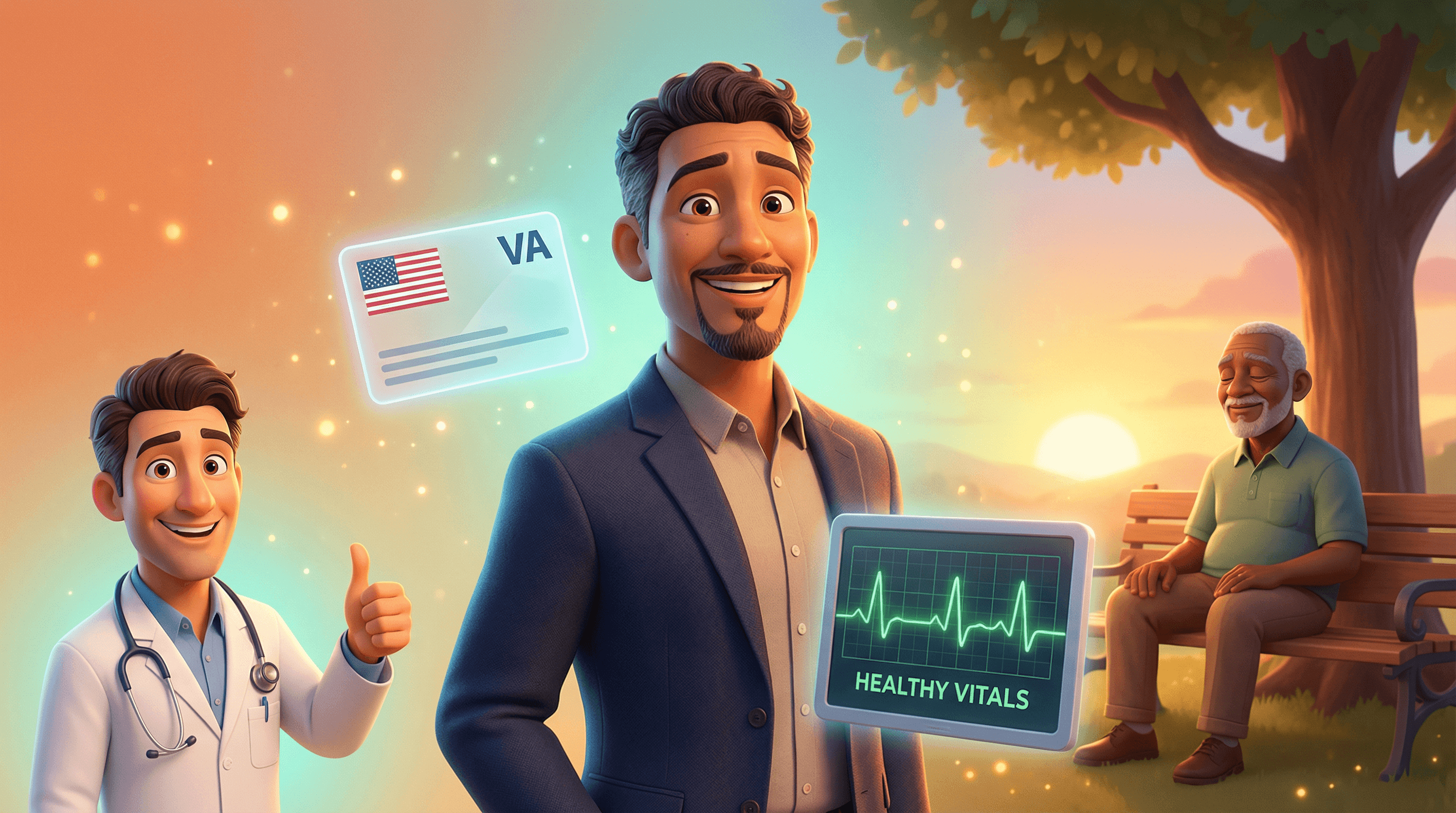
5. What's Coming on the YouTube Channel — Free Breakdowns on Everything We Covered
Perfect — that's actually the smarter move. One clean blog that covers everything at a high level, builds curiosity, and drives them to the YouTube channel for the deep dives. Here is Content - 5:
Content - 5
Heading: What's Coming on the YouTube Channel — Free Breakdowns on Everything We Covered
This blog was just the starting point. There is a lot more that I want to walk you through in detail and I am going to be doing that on YouTube where I can actually show you the screens, walk through the forms, and answer questions in real time. Here is what is coming up on the channel and what each video is going to cover.
Mental Health and PTSD Claims — This One Needs Its Own Video
I know this is the one a lot of guys skip. Either because of pride or because they don't think it counts or because they just don't want to talk about it. I get it. I've been there. But PTSD, anxiety, depression, and other mental health conditions connected to your service are fully claimable. And a mental health rating can push your overall percentage up in a way that changes your entire benefit picture. I'm going to break this one down on the channel — how to file it, what to say, and how to approach it without feeling like you're being dramatic. Because you're not. What we went through was real.
Chapter 31 Vocational Rehabilitation — The One That Helped Me Personally
This is the benefit that stepped in for me after my semi truck situation. Chapter 31 — also known as Voc Rehab — is a program that can pay for school, certifications, tools for a trade, and in some cases even help you start a business if it's tied to your service connected disability. But you can only access it if you have a disability rating first. That is one of the biggest reasons I tell people to file. Not for the monthly check. For the doors it opens. Full video breakdown coming on the channel.
They Denied You — Here Is What to Do Next
A lot of veterans get a denial letter and just accept it. They think that's the final answer. It is not. You have the right to file a supplemental claim with new evidence, request a higher level review, or appeal to the Board of Veterans Appeals. Most first time claims get pushed back in some form. That does not mean you give up. That means you come back with a better package. I'm going to walk through the entire appeals process step by step on the channel so you know exactly what to do if it happens to you.
Your Family Is Covered Too
This one surprises a lot of veterans. Depending on your rating your spouse and dependents may have access to healthcare through CHAMPVA, education benefits through the Dependents Educational Assistance program, and survivor compensation if something were to ever happen to you. Your service covered more than just you. Video coming on this one too.
How to Find Us and Ask Questions
All of this content is free. Always will be. If you have a specific question about your situation, your claim, or anything covered in this blog — come find us on YouTube and drop it in the comments. I read them. If your question is something a lot of people are dealing with I will make a video about it.
You can also reach out directly through the contact form on this site if you want to talk one on one.
We served together. The least I can do is make sure you know what you earned.

More to Discover


What Nobody Told Me About VA Benefits — A Cavalry Scout's Honest Take
I'm a 19D Cavalry Scout sergeant and nobody told me what I was entitled to when I got out. This is the blog I wish I had. Real talk on disability, the PACT Act, VA home loans, the GI Bill, and Texas benefits — from someone who lived it.
Insights
1. Let Me Introduce my self.
My name is Murillo. Former 19 Delta Cavalry Scout sergeant. Deployed overseas — got a good taste of South Korea (asia) Freezing mountains, the scorching deserts of Iraq, Kuwait, Syria. Ruck marches, division runs, endless days in the sun and the rain. The kind of stuff that you don't fully understand the impact of until years later when your body starts sending you the bill.
It took me a couple of times to realize how much of what I went through actually affected me. Not just physically — mentally too. I tried to make a career in the oil fields after getting out and I started noticing how much my body was genuinely hurting. Not everybody lands in the right job after service. Not everybody even knows where to start. That's part of why I'm doing this.
Here's the honest part — nobody sat me down and explained my benefits when I got out. But I also have to be real with myself. I didn't ask either. I was getting out during COVID when they were shutting everything down and I probably sham'd a little too hard and ended up skipping the VA benefits brief on my way out the door. For the longest time I simply did not know what I had access to.
For the guys that were in my team and my unit — you guys served right next to me. I know a lot of you. We may not agree on everything. But I know what it means to have your back covered no matter what. That bond is something I'll always be grateful for. And this blog is my way of giving a little bit back. You served. Let's make sure you actually get what you earned.
2. Why You Should At Least File — Even If You Think You Don't Qualify
Let me tell you something before anything else. Filing is not as scary as it sounds. I know it looks intimidating when you first pull up VA.gov. There's a lot going on. A lot of tabs. A lot of forms. But hear me out before you close the browser.
I'll be honest about my own experience. My original VSO filed a pension claim for me and I had no idea. I didn't find out until I sat down and started reading the regulations myself. That's when I realized I needed to understand this stuff on my own terms. Everything I'm sharing with you is from 2026 and it's something I'm actively working through myself. Videos are coming soon so I can walk you through it in more detail — I've just been buried in other projects. But I wanted to get something out for you guys in writing first.
Here's the real reason I think every veteran should at least file:
Even if you only get 30 percent — that's coverage you keep for life. And for the guys that went to combat zones with me, you are probably entitled to a lot more than you think. There has been years of research now on cancers, on long term effects, on conditions that show up years after you separate. Things that your body is dealing with right now that trace directly back to what we did over there.
For me personally — I almost crashed my semi truck because of a service connected issue with my arm. Years on the 50 cal. That's when it clicked. Something happened to me later in life that connected directly back to my service. Because I had my disability rating, I qualified for Chapter 31 Vocational Rehabilitation. I would not have been able to access that program without the disability rating in the first place.
That is what people don't understand. Filing for VA disability is not just about the monthly check. It is insurance. It is coverage. It is a door that opens other doors — healthcare, vocational rehab, adapted housing, education benefits — things you cannot access if you never filed.
And you don't have to BS anything to get it. You don't have to exaggerate. You just talk to them and tell them what your body has been through. MOS based claims are also a real thing — meaning the job you held in the military already supports certain conditions without you having to prove every single detail. If you humped a ruck through South Korea or ran missions in Iraq, your body has a story. Let the VA hear it.
First step — create your ID.me account and set up your VA.gov profile. That is where everything starts. I will have a full video walkthrough up soon. Until then, just start there.
3. How to Actually File — Step By Step From Someone Who Did It
Alright let's get into it. I'm going to walk you through this the way I wish someone had walked me through it. No law firm fees. No confusing government language. Just the steps.
Step 1 — Create Your ID.me Account and Get Into VA.gov Go to va.gov and log in through ID.me. This is your verified identity login that gives you access to everything. Once you're in, pull up your profile and check if you already have a VA provider assigned. If you don't, call them and let them know you need one. That's your starting point.
Step 2 — File Your Intent to File First This is something I want you to pay attention to. Filing an Intent to File is the first step because it preserves your effective date — and your effective date determines when your back pay starts from. Veterans Benefits Knowledge Base You can do this online at VA.gov in about two minutes. Even if your package isn't ready yet, file the intent first. It locks in your date. Every month you wait to file is money you cannot get back — at the 100 percent rate that's over $3,800 a month. Yourvabenefits Don't sleep on this step.
Step 3 — Get Your Diagnosis Whether you go through the VA or your own doctor, you need an official diagnosis. Here's the difference. If you go through the VA, schedule an appointment, tell them what's wrong, and they handle the rest internally. If you use a civilian doctor, you will need what's called a nexus letter. Don't let that word scare you. A nexus letter is simply a letter from your doctor stating that your condition is "at least as likely as not" related to your military service. Homefrontgroup That phrase — at least as likely as not — is the exact language the VA needs to see. Make sure your doctor uses those words.
When you go to that appointment — VA or civilian — do not describe how you feel on your best day. Tell them about your worst days. Tell them how often it affects you. My knee doesn't always hurt but it hurts every twenty or thirty minutes with random consistent pain — that's the kind of detail they need. Don't give them your football injury. Don't give them anything that isn't directly connected to your service. Stay focused.
Step 4 — Build Your Package Once you have your diagnosis you start putting your package together. Here's what you need:
DD-214 — this is your master key. It is the official proof of your military service and your discharge status. Everything in the VA system starts here. Homefrontgroup
Personal Statement — this is your story in writing. Be detailed. Be specific. For my semi truck situation I wrote out exactly what happened — I was driving a 1998 Peterbilt from Midland to Fort Worth, I had been having numbing issues in my arm since before I got out of service, the VA never saw me for it, and one day on the highway I couldn't downshift to brake. I wrote all of that down. Dates, details, circumstances. That's what a personal statement looks like.
Buddy Statements — these are lay or witness statements submitted on VA Form 21-10210. VA These can come from people you served with, family members, anyone who witnessed your condition or how it affected you. The VA must consider buddy statements as long as they are consistent with the places, types, and circumstances of your military service. Veterans Benefits Knowledge Base Make sure whoever writes yours includes specific dates and details. Vague statements don't help you. Specific ones do.
Step 5 — Submit Your Claim Once your package is together go to VA.gov and file using VA Form 21-526EZ. If you submit all your evidence at the same time as your claim it qualifies as a Fully Developed Claim which typically processes faster. VA Upload everything — your DD-214, diagnosis, personal statement, buddy statements, nexus letter if applicable.
Now here's where I'll be honest about my personal approach. Technically you should file the Intent to File first to lock in your date and then take time to build your package. Some people file the claim right away with whatever they have. I personally get my whole package together first and then file. That's just how I do it. Either way — do not skip the Intent to File. That date matters.
One Last Thing Do not go into your C&P exam — that's your compensation and pension exam the VA schedules — and downplay what you're dealing with. Many veterans describe their symptoms on their best days out of habit or pride. Describe your worst days. If pain affects your sleep, your work, or your relationships, say it out loud. Usmilitary You are not complaining. You are telling the truth about what your service did to your body. There is nothing to be ashamed of.
Videos walking through each of these steps in detail are coming soon to the channel. Subscribe so you don't miss them.
4. What You Actually Get — Disabled vs Non-Disabled Veterans Side By Side
Here is Content - 4 written in your voice with everything backed by research:
Content - 4
Heading: What You Actually Get — Disabled vs Non-Disabled Veterans Side By Side
This is the part that I really want people to sit with. Because there is a significant difference between what a veteran with no disability rating gets versus what a veteran with even a 10 or 30 percent rating gets. And most people don't realize how wide that gap actually is until they see it laid out.
Let me break it down.
If You Have No Disability Rating
You still have access to some VA benefits — don't get me wrong. The GI Bill, the VA home loan, basic healthcare if you meet certain eligibility windows — those things are available to most veterans. But without a service connected disability rating your healthcare access is limited. You may face copays. Your priority group is lower which means longer waits and fewer covered services. You do not qualify for monthly tax free compensation. You do not qualify for Chapter 31 Vocational Rehabilitation. You do not qualify for adaptive housing grants. And a lot of the doors that open at 30, 50, 70, and 100 percent simply stay closed.
If You Have a 0% Rating — Yes, Even 0% Matters
Here's something most veterans don't know. A 0 percent service connected rating still establishes the connection between your condition and your service. That matters because you can file for an increase if the condition gets worse, you qualify for VA healthcare related to that condition, and it can support future secondary claims. Usmilitary A 0 percent is not a rejection. It is a foothold. Build from it.
10% — The First Real Door Opens
At 10 percent, by law the VA covers your copays — meaning if you are rated at even 10 percent, the VA pays your private insurance copay and bills your insurance for the care itself. You owe nothing to either your insurance or the VA. Veterans Benefits Knowledge Base That alone is worth filing for. You also get access to VA healthcare, prescription coverage, and you are now in the system building your record for future increases.
30% and Above — Your Family Starts Benefiting Too
At 30 percent your monthly compensation goes up and you start receiving additional pay for dependents — meaning your spouse and kids are factored into your monthly check. In Texas, veterans with a service connected disability rating of at least 30 percent also qualify for a discounted interest rate on a Texas Veterans Housing Assistance Program loan. Nolo The benefits are stacking at this point.
70% and Above — This Is Where It Gets Serious
At 70 percent you are enrolled in VA Health Care Priority Group 1 — the highest priority group — meaning you receive comprehensive healthcare through the VA with no copayments for services. US Military At this level you also become eligible to apply for Total Disability based on Individual Unemployability — TDIU — which means if your service connected conditions prevent you from maintaining gainful employment, the VA can pay you at the 100 percent rate even if your combined rating is below 100. US Military That is a massive benefit that most veterans at this level don't even know exists.
100% — The Full Picture
At 100 percent your monthly tax free compensation starts at $3,831 per month with no dependents and increases based on your family situation. Ocelder Law But the money is honestly not even the biggest part.
Here is what else comes with 100 percent:
Full VA healthcare at Priority Group 1 — free medical, dental, vision, hearing aids, and prescriptions Ocelder Law
In Texas — zero property taxes on your primary residence, saving some veterans over $6,000 a year Iwillbuyyourhouseforcash
Free or reduced vehicle registration, disabled veteran license plates, and in some states exemption from vehicle sales tax Hill & Ponton
Free access to all national parks and federal lands for you and everyone in your vehicle, plus 50 percent off camping at federal parks Veterans Guide
Dependents Educational Assistance — your family gets scholarship and tuition support Ocelder Law
Commissary and exchange privileges
Access to Chapter 31 Vocational Rehabilitation
Adaptive housing grants if your disability requires home modifications
Guaranteed acceptance life insurance through VALife without a medical exam
The Point Is This
Every rating level unlocks something. Even 10 percent changes your situation. Even 0 percent gets your foot in the door. The veterans I worry about are the ones who never filed at all — who are out here paying out of pocket for healthcare, missing tax exemptions, and sitting on benefits they earned but never claimed because nobody explained it to them.
I was one of those guys. Don't be that guy. Go file.
5. What's Coming on the YouTube Channel — Free Breakdowns on Everything We Covered
Perfect — that's actually the smarter move. One clean blog that covers everything at a high level, builds curiosity, and drives them to the YouTube channel for the deep dives. Here is Content - 5:
Content - 5
Heading: What's Coming on the YouTube Channel — Free Breakdowns on Everything We Covered
This blog was just the starting point. There is a lot more that I want to walk you through in detail and I am going to be doing that on YouTube where I can actually show you the screens, walk through the forms, and answer questions in real time. Here is what is coming up on the channel and what each video is going to cover.
Mental Health and PTSD Claims — This One Needs Its Own Video
I know this is the one a lot of guys skip. Either because of pride or because they don't think it counts or because they just don't want to talk about it. I get it. I've been there. But PTSD, anxiety, depression, and other mental health conditions connected to your service are fully claimable. And a mental health rating can push your overall percentage up in a way that changes your entire benefit picture. I'm going to break this one down on the channel — how to file it, what to say, and how to approach it without feeling like you're being dramatic. Because you're not. What we went through was real.
Chapter 31 Vocational Rehabilitation — The One That Helped Me Personally
This is the benefit that stepped in for me after my semi truck situation. Chapter 31 — also known as Voc Rehab — is a program that can pay for school, certifications, tools for a trade, and in some cases even help you start a business if it's tied to your service connected disability. But you can only access it if you have a disability rating first. That is one of the biggest reasons I tell people to file. Not for the monthly check. For the doors it opens. Full video breakdown coming on the channel.
They Denied You — Here Is What to Do Next
A lot of veterans get a denial letter and just accept it. They think that's the final answer. It is not. You have the right to file a supplemental claim with new evidence, request a higher level review, or appeal to the Board of Veterans Appeals. Most first time claims get pushed back in some form. That does not mean you give up. That means you come back with a better package. I'm going to walk through the entire appeals process step by step on the channel so you know exactly what to do if it happens to you.
Your Family Is Covered Too
This one surprises a lot of veterans. Depending on your rating your spouse and dependents may have access to healthcare through CHAMPVA, education benefits through the Dependents Educational Assistance program, and survivor compensation if something were to ever happen to you. Your service covered more than just you. Video coming on this one too.
How to Find Us and Ask Questions
All of this content is free. Always will be. If you have a specific question about your situation, your claim, or anything covered in this blog — come find us on YouTube and drop it in the comments. I read them. If your question is something a lot of people are dealing with I will make a video about it.
You can also reach out directly through the contact form on this site if you want to talk one on one.
We served together. The least I can do is make sure you know what you earned.
More to Discover
What Nobody Told Me About VA Benefits — A Cavalry Scout's Honest Take
I'm a 19D Cavalry Scout sergeant and nobody told me what I was entitled to when I got out. This is the blog I wish I had. Real talk on disability, the PACT Act, VA home loans, the GI Bill, and Texas benefits — from someone who lived it.
Insights
1. Let Me Introduce my self.
My name is Murillo. Former 19 Delta Cavalry Scout sergeant. Deployed overseas — got a good taste of South Korea (asia) Freezing mountains, the scorching deserts of Iraq, Kuwait, Syria. Ruck marches, division runs, endless days in the sun and the rain. The kind of stuff that you don't fully understand the impact of until years later when your body starts sending you the bill.
It took me a couple of times to realize how much of what I went through actually affected me. Not just physically — mentally too. I tried to make a career in the oil fields after getting out and I started noticing how much my body was genuinely hurting. Not everybody lands in the right job after service. Not everybody even knows where to start. That's part of why I'm doing this.
Here's the honest part — nobody sat me down and explained my benefits when I got out. But I also have to be real with myself. I didn't ask either. I was getting out during COVID when they were shutting everything down and I probably sham'd a little too hard and ended up skipping the VA benefits brief on my way out the door. For the longest time I simply did not know what I had access to.
For the guys that were in my team and my unit — you guys served right next to me. I know a lot of you. We may not agree on everything. But I know what it means to have your back covered no matter what. That bond is something I'll always be grateful for. And this blog is my way of giving a little bit back. You served. Let's make sure you actually get what you earned.
2. Why You Should At Least File — Even If You Think You Don't Qualify
Let me tell you something before anything else. Filing is not as scary as it sounds. I know it looks intimidating when you first pull up VA.gov. There's a lot going on. A lot of tabs. A lot of forms. But hear me out before you close the browser.
I'll be honest about my own experience. My original VSO filed a pension claim for me and I had no idea. I didn't find out until I sat down and started reading the regulations myself. That's when I realized I needed to understand this stuff on my own terms. Everything I'm sharing with you is from 2026 and it's something I'm actively working through myself. Videos are coming soon so I can walk you through it in more detail — I've just been buried in other projects. But I wanted to get something out for you guys in writing first.
Here's the real reason I think every veteran should at least file:
Even if you only get 30 percent — that's coverage you keep for life. And for the guys that went to combat zones with me, you are probably entitled to a lot more than you think. There has been years of research now on cancers, on long term effects, on conditions that show up years after you separate. Things that your body is dealing with right now that trace directly back to what we did over there.
For me personally — I almost crashed my semi truck because of a service connected issue with my arm. Years on the 50 cal. That's when it clicked. Something happened to me later in life that connected directly back to my service. Because I had my disability rating, I qualified for Chapter 31 Vocational Rehabilitation. I would not have been able to access that program without the disability rating in the first place.
That is what people don't understand. Filing for VA disability is not just about the monthly check. It is insurance. It is coverage. It is a door that opens other doors — healthcare, vocational rehab, adapted housing, education benefits — things you cannot access if you never filed.
And you don't have to BS anything to get it. You don't have to exaggerate. You just talk to them and tell them what your body has been through. MOS based claims are also a real thing — meaning the job you held in the military already supports certain conditions without you having to prove every single detail. If you humped a ruck through South Korea or ran missions in Iraq, your body has a story. Let the VA hear it.
First step — create your ID.me account and set up your VA.gov profile. That is where everything starts. I will have a full video walkthrough up soon. Until then, just start there.
3. How to Actually File — Step By Step From Someone Who Did It
Alright let's get into it. I'm going to walk you through this the way I wish someone had walked me through it. No law firm fees. No confusing government language. Just the steps.
Step 1 — Create Your ID.me Account and Get Into VA.gov Go to va.gov and log in through ID.me. This is your verified identity login that gives you access to everything. Once you're in, pull up your profile and check if you already have a VA provider assigned. If you don't, call them and let them know you need one. That's your starting point.
Step 2 — File Your Intent to File First This is something I want you to pay attention to. Filing an Intent to File is the first step because it preserves your effective date — and your effective date determines when your back pay starts from. Veterans Benefits Knowledge Base You can do this online at VA.gov in about two minutes. Even if your package isn't ready yet, file the intent first. It locks in your date. Every month you wait to file is money you cannot get back — at the 100 percent rate that's over $3,800 a month. Yourvabenefits Don't sleep on this step.
Step 3 — Get Your Diagnosis Whether you go through the VA or your own doctor, you need an official diagnosis. Here's the difference. If you go through the VA, schedule an appointment, tell them what's wrong, and they handle the rest internally. If you use a civilian doctor, you will need what's called a nexus letter. Don't let that word scare you. A nexus letter is simply a letter from your doctor stating that your condition is "at least as likely as not" related to your military service. Homefrontgroup That phrase — at least as likely as not — is the exact language the VA needs to see. Make sure your doctor uses those words.
When you go to that appointment — VA or civilian — do not describe how you feel on your best day. Tell them about your worst days. Tell them how often it affects you. My knee doesn't always hurt but it hurts every twenty or thirty minutes with random consistent pain — that's the kind of detail they need. Don't give them your football injury. Don't give them anything that isn't directly connected to your service. Stay focused.
Step 4 — Build Your Package Once you have your diagnosis you start putting your package together. Here's what you need:
DD-214 — this is your master key. It is the official proof of your military service and your discharge status. Everything in the VA system starts here. Homefrontgroup
Personal Statement — this is your story in writing. Be detailed. Be specific. For my semi truck situation I wrote out exactly what happened — I was driving a 1998 Peterbilt from Midland to Fort Worth, I had been having numbing issues in my arm since before I got out of service, the VA never saw me for it, and one day on the highway I couldn't downshift to brake. I wrote all of that down. Dates, details, circumstances. That's what a personal statement looks like.
Buddy Statements — these are lay or witness statements submitted on VA Form 21-10210. VA These can come from people you served with, family members, anyone who witnessed your condition or how it affected you. The VA must consider buddy statements as long as they are consistent with the places, types, and circumstances of your military service. Veterans Benefits Knowledge Base Make sure whoever writes yours includes specific dates and details. Vague statements don't help you. Specific ones do.
Step 5 — Submit Your Claim Once your package is together go to VA.gov and file using VA Form 21-526EZ. If you submit all your evidence at the same time as your claim it qualifies as a Fully Developed Claim which typically processes faster. VA Upload everything — your DD-214, diagnosis, personal statement, buddy statements, nexus letter if applicable.
Now here's where I'll be honest about my personal approach. Technically you should file the Intent to File first to lock in your date and then take time to build your package. Some people file the claim right away with whatever they have. I personally get my whole package together first and then file. That's just how I do it. Either way — do not skip the Intent to File. That date matters.
One Last Thing Do not go into your C&P exam — that's your compensation and pension exam the VA schedules — and downplay what you're dealing with. Many veterans describe their symptoms on their best days out of habit or pride. Describe your worst days. If pain affects your sleep, your work, or your relationships, say it out loud. Usmilitary You are not complaining. You are telling the truth about what your service did to your body. There is nothing to be ashamed of.
Videos walking through each of these steps in detail are coming soon to the channel. Subscribe so you don't miss them.
4. What You Actually Get — Disabled vs Non-Disabled Veterans Side By Side
Here is Content - 4 written in your voice with everything backed by research:
Content - 4
Heading: What You Actually Get — Disabled vs Non-Disabled Veterans Side By Side
This is the part that I really want people to sit with. Because there is a significant difference between what a veteran with no disability rating gets versus what a veteran with even a 10 or 30 percent rating gets. And most people don't realize how wide that gap actually is until they see it laid out.
Let me break it down.
If You Have No Disability Rating
You still have access to some VA benefits — don't get me wrong. The GI Bill, the VA home loan, basic healthcare if you meet certain eligibility windows — those things are available to most veterans. But without a service connected disability rating your healthcare access is limited. You may face copays. Your priority group is lower which means longer waits and fewer covered services. You do not qualify for monthly tax free compensation. You do not qualify for Chapter 31 Vocational Rehabilitation. You do not qualify for adaptive housing grants. And a lot of the doors that open at 30, 50, 70, and 100 percent simply stay closed.
If You Have a 0% Rating — Yes, Even 0% Matters
Here's something most veterans don't know. A 0 percent service connected rating still establishes the connection between your condition and your service. That matters because you can file for an increase if the condition gets worse, you qualify for VA healthcare related to that condition, and it can support future secondary claims. Usmilitary A 0 percent is not a rejection. It is a foothold. Build from it.
10% — The First Real Door Opens
At 10 percent, by law the VA covers your copays — meaning if you are rated at even 10 percent, the VA pays your private insurance copay and bills your insurance for the care itself. You owe nothing to either your insurance or the VA. Veterans Benefits Knowledge Base That alone is worth filing for. You also get access to VA healthcare, prescription coverage, and you are now in the system building your record for future increases.
30% and Above — Your Family Starts Benefiting Too
At 30 percent your monthly compensation goes up and you start receiving additional pay for dependents — meaning your spouse and kids are factored into your monthly check. In Texas, veterans with a service connected disability rating of at least 30 percent also qualify for a discounted interest rate on a Texas Veterans Housing Assistance Program loan. Nolo The benefits are stacking at this point.
70% and Above — This Is Where It Gets Serious
At 70 percent you are enrolled in VA Health Care Priority Group 1 — the highest priority group — meaning you receive comprehensive healthcare through the VA with no copayments for services. US Military At this level you also become eligible to apply for Total Disability based on Individual Unemployability — TDIU — which means if your service connected conditions prevent you from maintaining gainful employment, the VA can pay you at the 100 percent rate even if your combined rating is below 100. US Military That is a massive benefit that most veterans at this level don't even know exists.
100% — The Full Picture
At 100 percent your monthly tax free compensation starts at $3,831 per month with no dependents and increases based on your family situation. Ocelder Law But the money is honestly not even the biggest part.
Here is what else comes with 100 percent:
Full VA healthcare at Priority Group 1 — free medical, dental, vision, hearing aids, and prescriptions Ocelder Law
In Texas — zero property taxes on your primary residence, saving some veterans over $6,000 a year Iwillbuyyourhouseforcash
Free or reduced vehicle registration, disabled veteran license plates, and in some states exemption from vehicle sales tax Hill & Ponton
Free access to all national parks and federal lands for you and everyone in your vehicle, plus 50 percent off camping at federal parks Veterans Guide
Dependents Educational Assistance — your family gets scholarship and tuition support Ocelder Law
Commissary and exchange privileges
Access to Chapter 31 Vocational Rehabilitation
Adaptive housing grants if your disability requires home modifications
Guaranteed acceptance life insurance through VALife without a medical exam
The Point Is This
Every rating level unlocks something. Even 10 percent changes your situation. Even 0 percent gets your foot in the door. The veterans I worry about are the ones who never filed at all — who are out here paying out of pocket for healthcare, missing tax exemptions, and sitting on benefits they earned but never claimed because nobody explained it to them.
I was one of those guys. Don't be that guy. Go file.
5. What's Coming on the YouTube Channel — Free Breakdowns on Everything We Covered
Perfect — that's actually the smarter move. One clean blog that covers everything at a high level, builds curiosity, and drives them to the YouTube channel for the deep dives. Here is Content - 5:
Content - 5
Heading: What's Coming on the YouTube Channel — Free Breakdowns on Everything We Covered
This blog was just the starting point. There is a lot more that I want to walk you through in detail and I am going to be doing that on YouTube where I can actually show you the screens, walk through the forms, and answer questions in real time. Here is what is coming up on the channel and what each video is going to cover.
Mental Health and PTSD Claims — This One Needs Its Own Video
I know this is the one a lot of guys skip. Either because of pride or because they don't think it counts or because they just don't want to talk about it. I get it. I've been there. But PTSD, anxiety, depression, and other mental health conditions connected to your service are fully claimable. And a mental health rating can push your overall percentage up in a way that changes your entire benefit picture. I'm going to break this one down on the channel — how to file it, what to say, and how to approach it without feeling like you're being dramatic. Because you're not. What we went through was real.
Chapter 31 Vocational Rehabilitation — The One That Helped Me Personally
This is the benefit that stepped in for me after my semi truck situation. Chapter 31 — also known as Voc Rehab — is a program that can pay for school, certifications, tools for a trade, and in some cases even help you start a business if it's tied to your service connected disability. But you can only access it if you have a disability rating first. That is one of the biggest reasons I tell people to file. Not for the monthly check. For the doors it opens. Full video breakdown coming on the channel.
They Denied You — Here Is What to Do Next
A lot of veterans get a denial letter and just accept it. They think that's the final answer. It is not. You have the right to file a supplemental claim with new evidence, request a higher level review, or appeal to the Board of Veterans Appeals. Most first time claims get pushed back in some form. That does not mean you give up. That means you come back with a better package. I'm going to walk through the entire appeals process step by step on the channel so you know exactly what to do if it happens to you.
Your Family Is Covered Too
This one surprises a lot of veterans. Depending on your rating your spouse and dependents may have access to healthcare through CHAMPVA, education benefits through the Dependents Educational Assistance program, and survivor compensation if something were to ever happen to you. Your service covered more than just you. Video coming on this one too.
How to Find Us and Ask Questions
All of this content is free. Always will be. If you have a specific question about your situation, your claim, or anything covered in this blog — come find us on YouTube and drop it in the comments. I read them. If your question is something a lot of people are dealing with I will make a video about it.
You can also reach out directly through the contact form on this site if you want to talk one on one.
We served together. The least I can do is make sure you know what you earned.